a nature preserve at the northern end of Appalachia
Author: Dave Bonta
I live in an Appalachian hollow in the Juniata watershed of central Pennsylvania, and spend a great deal of time walking in the woods. My books of poetry include FAILED STATE: HAIBUN, ICE MOUNTAIN: AN ELEGY, BREAKDOWN: BANJO POEMS, and ODES TO TOOLS.
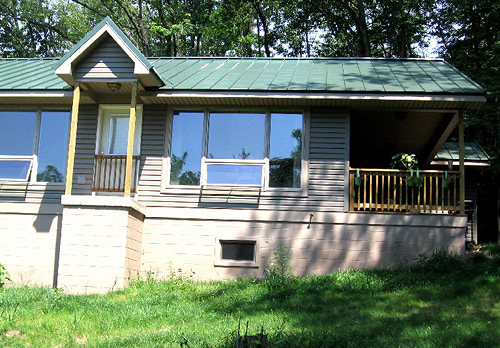
I have been remiss in not posting something about the newest residence in Plummer’s Hollow, which was completed a little less than a year ago. But my procrastination has paid off, and now you can read the whole story, and look at the photos, in my mom’s latest Pennsylvania Game News column, The Green House.
As you’ll see, we had the house built over at the old McHugh place to minimize its footprint. “Green” features include passive solar design, a geothermal heating and cooling system, and insulation made from blue jeans. We are delighted to have Troy and Paula Scott as neighbors, caretakers, and — as noted in the previous post — fellow naturalists.
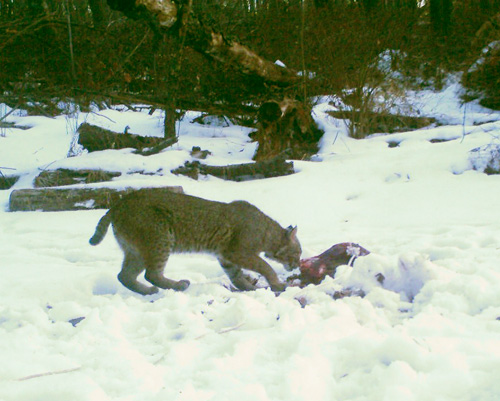
Starting late last summer, some of the hunters on the property have been using game cams to better track deer and other wildlife. Game cams are motion-triggered, sturdy, outdoor cameras increasingly popular among outdoors enthusiasts, and sometimes scientists, too. Troy and Paula Scott, Jeff Scott, and Troy Scott Jr. have all been involved in this project, but Paula has been the most persistent. A few days ago, her efforts were rewarded in a big way when a game cam she positioned near a bobcat scat and baited with venison caught a full-grown bobcat in the act at 7:36 AM, 1/21/10.
Another hunter had already seen a bobcat from his tree stand during deer season in December, and we’d seen other sign of it, as mentioned, so this wasn’t a huge surprise, just really nice to document. Another game cam capture from January 18 was a little more surprising because it showed that at least one gray fox is still resident on the mountain. After a rabies epidemic swept through two summers ago, we had our doubts.
We don’t permit any predator hunting or trapping on the property, so the game cams offer a neat way for the hunters to pursue this kind of quarry without harming it — and help document wildlife populations in the process. We’re grateful to Paula and the others for taking the initiative. It also seemed as if they were especially persistent in their deer hunting this year in part because they had a pretty good idea from the cameras of how many bucks and does were present — important knowledge on a year when deer numbers were down generally.
One game cam snapped some cute photos of a black bear cub back on September 15. Here’s the best of them:
My sledding video from last winter was such a success, I thought I’d try it again this year. The conditions were pretty icy and scary last winter, so I stopped at the half-way point, not wanting to risk the video camera any farther. (I hold it in my right hand as I ride — this isn’t a helmet cam.) But this winter, given all the wonderful cold weather and regular snow, sledding conditions have been exceptional, and with the January thaw imminent, yesterday afternoon I went ahead and shot this video of a sled ride clear to the bottom, a mile-and-a-half-long run. It isn’t quite non-stop, as you’ll see: there are two places, slight uphills on the way down, where I had to get out and walk for a few yards. The first is the half-way spot where I stopped in last winter’s video.
Since I was on hard-packed snow rather than ice this time, the ride was relatively quiet. It’s the quiet that I love about sledding, as much as the speed, so I decided to dispense with rousing music in the soundtrack and go for straight realism. (Actually, a little less realism might’ve been nice, but unfortunately my camera doesn’t have image stabilization. I also apologize for all the sniffing — but that too is the sound of winter, isn’t it?)
Blogged at much greater length at my personal site, Via Negativa.
Snow on October 15! At first it was fun. Rolling balls for the snowman, I had to keep stopping to pull out black walnut leaf ribs — enough to make three dozen Eves, at least. Sure, give him a blaze-orange cap. Maybe he’ll come to life and wreak some minor havoc.
Snow fell throughout the afternoon and evening, fell faster than it could melt onto a ground that was still unfrozen. (Hell, we’d just gotten our first frost the day before!) By Friday morning, the power was out and the phone was dead. There were three to four inches of heavy, wet snow in the vicinity of the houses, and five inches at the top of the field. Sitting outside to drink my coffee around 8:00, it sounded as bad as any icestorm we’ve ever had, with loud cracks and crashes every few seconds. The trees seemed to be taking “fall” a bit too literally.
The bigger-leaved trees took it the worst: oaks, maples, tulip poplars, black locusts, and cucumber magnolias all suffered extensive pruning and occasional bole-snap. The damage was localized, presumably corresponding to wherever snow fell the hardest and stuck the longest. This was a very elevation-dependent snowfall throughout the region.
Numerous limbs and broken treetops, and around a dozen toppled mature trees, came down across the Plummer’s Hollow Boulevard. It took our new neighbors and caretakers, Troy and Paula Scott, two days to clear them all. Damage petered out along with the snow about a quarter mile from the bottom.
We’ve had October snows before, but none so heavy or so early. Of course it was beautiful — but some kinds of beauty we could definitely do without.
Plenty more damaging storms have hit Plummer’s Hollow, but it’s been a while since the oaks have taken this hard a beating. Icestorms rarely affect them. Although of course that’s in part because icestorms generally don’t occur until after the leaves are all down… knock on wood.
Here’s a video that combines some footage I shot in July with some from last Sunday. Our new caretaker Troy Scott can be heard in both parts, joined by his son Andy in the second part. It was Troy who spotted the snake each time, though I’ve seen it in previous years; it seems to be regular summer visitor. When Dad and I replaced the guest house bathroom 10 years ago, we found lots of snakes: milk snakes, a few garter snakes, and one big black snake in the ceiling — possibly this very individual.
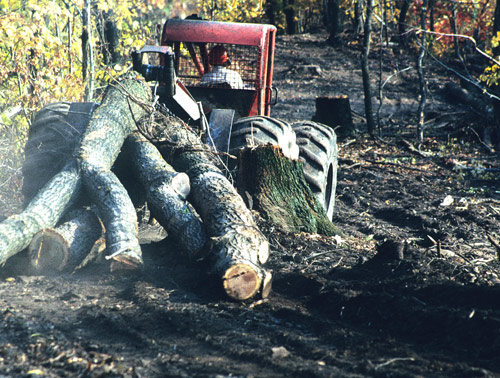
A Helsel skidder hauling logs out of Plummer's Hollow, 1991
We were interested to read in the local paper that the Blair County-based Helsel Lumber Mill has fallen on hard times. Ralph Helsel was the lumberman described in Marcia’s book Appalachian Autumn, who believed that it was his divinely ordained mission to harvest “overmature” trees, which in any case “wanted to be cut,” and who put his beliefs in practice on the 120-acre McHugh tract in Plummer’s Hollow. (We subsequently purchased the tract from a third party, after it had been mostly clearcut.) It seems that overmature companies may be subject to a similar fate.
A Blue Knob lumber mill that has been operating for 81 years and most recently doing business with China may soon be filing for reorganization under bankruptcy laws because of the downturn in the economy, according to its president, Charles Salyards Jr.
At one time, Helsel Lumber Mill of 3446 Johnstown Road [Route 164] did $6 million to $8 million in business annually and had 85 employees, Salyards said.
The demand for wood products, however, dropped dramatically in the past 18 months because of the lack of new housing construction and rehabilitation on the domestic side and the high cost of fuel, which affected the international market.
Business dropped to one-third of peak levels in 2008, Salyards said. As of late last year, the mill has been shut down.
“Every tree we cut, we were losing money,” Salyards said.
While we feel for the employees who have lost their jobs, we can’t help noting that the lumber company’s past decision to export much of its lumber to China contributed to the loss of many more state and regional jobs in the value-added hardwood products industry.
Mills like Helsel Lumber provide the wood to furniture makers. While once many furniture makers were in North Carolina, in recent years, the business shifted to China.
The wood producers followed the manufacturers, but the overseas business suffered when the bottom fell out of the housing market worldwide, Craig said.
Production of wood products in the state is down 40 percent, he said.
And it almost goes without saying that Helsel never could have afforded to ship logs from Pennsylvania all the way to China for the production of furniture designed for export back to the United States, if they weren’t able to take advantage of an economic system in which environmental costs — such as the generation of carbon dioxide via logging and global transport — can be excluded from the balance sheets.
As luck would have it, the other major culprit in the 1991 trashing of Plummer’s Hollow has also been active in selling out our natural heritage to foreign corporations. One of consulting forester Michael Barton’s main clients now is the Spanish energy giant Gamesa, which has been bullying township supervisors and battling grassroots environmental groups all over central and western Pennsylvania for the right to erect industrial wind plants on our ridgetops, reaping huge windfalls from U.S. taxpayers in the process. Mr. Barton’s talent for putting lipstick on pigs, which we first encountered in 1991, has been put to good use in newspaper op-eds defending Gamesa. He has even proposed the construction of a nonprofit wind education center to encourage wind tubine-centered tourism. If you’re the sort of person who imagines picnic tables and swingsets when you see a sign for an industrial park, then you’ve got a friend in Pennsylvania.
Eroded tracks left by the Helseling of Plummer's Hollow, winter of 1991-92
Where nature’s concerned, it’s a cliché to say that every year’s different, but that doesn’t stop us from being struck by this simple truth anew each spring. This year in Plummer’s Hollow, certain absences seem especially worthy of note: chipmunk, garlic mustard, and wood thrush numbers are all down dramatically from last year. Our feelings about each decline, however, are quite different.
Chipmunks
chipmunk in Canada mayflowersEastern chipmunk populations follow a several-year boom and bust pattern, and we’re currently in a bust. Last year at this time, you couldn’t walk ten paces in the woods without another chipmunk chittering alarm and diving for cover. This year you’re lucky to see two or three chipmunks per mile. Last Tuesday, a speaker at our local Audubon chapter’s monthly meeting, Dr. Steven Latta from the National Aviary in Pittsburgh, confirmed my suspicion that the chipmunk cycle is tied to the acorn cycle.
Oaks fall into two sub-genus clades: the red oak group of species, which take two years to produce a crop, and the white oak group, which produce acorns every year — barring a crop failure. We have roughly equal numbers of each group on the property. Black, red, and especially scarlet oaks are common on the drier slopes, while chestnut oaks, which are in the white oak group, predominate on the ridgetops. In addition, the Larel Ridge part of the old powerline right-of-way that bisects the upper part of the hollow near the houses has turned into a scrub oak barrens, and scrub oaks are also in the group that masts almost every year — except this past year. Last fall was the off-year for the red oak group, and in addition, the unusually cold and wet conditions during pollination time last May led to a total crop failure of oaks in the white oak group. We didn’t see a single acorn on the mountain. The acorn failure was so widespread in the northeast, it even made the national news.
Dr. Latta’s talk was about Louisiana waterthrushes as indicators of riparian habitat quality, but he mentioned chipmunks in passing: they’re a major nest-predator for ground-dwelling birds, he said, eating the nestlings whenever they find them. (It’s a good bet that ovenbirds, a waterthrush congener also found in the hollow, are heavily impacted by chipmunks during boom years as well.) Latta thought that chipmunk populations in western Pennsylvania, where his study sites are located, probably would’ve crashed this year anyway, due to disease, but he felt that the natually cyclic nature of acorn production by the red oak group is behind the fluctuations in chipmunk numbers.
So this year’s dramatic decline in the chipmunk population is natural then, and therefore nothing to worry about, right? Well, I don’t know. Nothing is ever that simple where ecology is concerned. Oaks are far from the only mast-producing tree or shrub in the woods — if they were, there wouldn’t be any chipmunks right now. As the example of nest predation shows, chipmunks, like squirrels, are resourceful omnivores. Maple and birch seeds may be a far less nutritious substitute for acorns, but they’re plantiful as hell. The dramatic, region-wide increase of black birches and red maples as a percentage of forest cover in recent decades must help cushion chipmunk populations to some extent.
Then there are hickories: once a major component of Appalachian ridgetop forests such as ours, and perhaps again in coming decades as the forests age: hickories are very slow-growing trees. American beech and eastern hemlock, by contrast, will be dropping out of the mast-tree equation as they succumb to an introduced blight and insect pest, respectively. (Beech bark disease has yet to hit Plummer’s hollow, but we figure it’s probably only a matter of time. Most of the mature American beeches in the northern counties of Pensylvania have already died.)
By far the biggest change to our forest in the last hundred years, however, was the almost total loss of the American chestnut due to the devastating effects of the Asian chestnut blight. We do have plenty of sprouts, which occasionally get big enough to flower and bear fruit before succumbing to the blight, and who knows how many more sprouts are eaten by the deer, so it’s safe to say that Plummer’s Hollow must’ve fit the Appalachian mold. A hundred years ago, chestnuts would’ve formed an almost unbroken carpet on the forest floor every year. It will be centuries, probably, before a blight-resistant chestnut re-colonizes the forest, and in the meantime, populations of rodents such as chipmunks, squirrels and mice, and who knows how many other wildlife species, will remain especially vulnerable to acorn crop failure as climate change brings more frequent wet Mays and late frosts.
This is a good example of how ecosystems lose resilience with each decline in biodiversity. In the case of chestnuts, their habit of flowering in June after all frost danger is past made them a more dependable mast species than, for example, the chestnut oaks. And while oaks are wind-pollinated, and therefore especially vulnerable to weather conditions, chestnuts are insect pollinated. My brother Steve and I happened upon a rare grove of flowering American chestnuts in a clearning in a nearby state forest last year, and we were astonished by the number and diversity of long-horned beetles swarming over their fuzzy yellow inflorescences. Steve is a beetle collector who has spent a lot of time in tropical forests, and he said he’d never seen such a concentration of Cerambycidae anywhere. Their numbers on that particular day might have simply been a reflection of the age of the surrounding forest — some ecologists consider long-horned beetle diversity to be an index of forest age, since their larvae live in dead trees. But we found it sobering to realize just what an insect bonanza must have been lost with the functional extirpation of the American chestnut.
Garlic mustard
Garlic mustard is an alien invasive species that first appeared in the hollow some fifteen years ago. It’s uniquely shade-tolerant, allowing it to compete with native wildflowers already under seige throughout the northeast by white-tailed deer. But this year, for the first time, we’ve noticed a decline in the number of flowering garlic mustards. We’re not sure what to attribute this to, and expect that, like the chipmunk decline, it’s only a temporary thing — though we’d love to be wrong about that. I had originally thought that perhaps last spring’s wet weather inhibited pollination, and perhaps it did, but that wouldn’t explain the decline in flowering stalks this year; it’s a biennial.
Like many non-native plants, garlic mustard is invasive because it has escaped the control of whatever insects, herbivores and diseases kept it in check back home (Europe, Asia, and North Africa). It can take a long time for native insects and diseases to adapt to an invasive plant species and rein it in, and in the meantime it can cause all sort of ecological havoc. Here’s how the National Park Service’s Alien Plant Working Group summarizes the case against Alliara petiolata:
Garlic mustard poses a severe threat to native plants and animals in forest communities in much of the eastern and midwestern U.S. Many native widlflowers that complete their life cycles in the springtime (e.g., spring beauty, wild ginger, bloodroot, Dutchman’s breeches, hepatica, toothworts, and trilliums) occur in the same habitat as garlic mustard. Once introduced to an area, garlic mustard outcompetes native plants by aggressively monopolizing light, moisture, nutrients, soil and space. Wildlife species that depend on these early plants for their foliage, pollen, nectar, fruits, seeds and roots, are deprived of these essential food sources when garlic mustard replaces them. Humans are also deprived of the vibrant display of beautiful spring wildflowers.
Garlic mustard also poses a threat to one of our rare native insects, the West Virginia white butterfly (Pieris virginiensis). Several species of spring wildflowers known as “toothworts” (Dentaria), also in the mustard family, are the primary food source for the caterpillar stage of this butterfly. Invasions of garlic mustard are causing local extirpations of the toothworts, and chemicals in garlic mustard appear to be toxic to the eggs of the butterfly, as evidenced by their failure to hatch when laid on garlic mustard plants.
So in this case, we’d love the current decline to turn into a long-term trend, but we suspect that it’s really only a temporary set-back.
Wood thrush
a wood thrush, slightly stunned by a collision with a window
Where wood thrushes are concerned, however, I’m afraid this year’s virtual absence of singing thrushes in the woods near the houses, while probably in part incidental to where territory boundaries happen to have fallen this year, actually is part of a long-term decline — and one which, in contrast with garlic mustard, we do not welcome. Their ethereal, elegiac-sounding calls at dawn and dusk, from May through July, are something I look forward to all winter long, so it’s very sad to think that we may never again experience a woods ringing with thrush song as we did back in the 1970s.
One July evening, along the Short Circuit Trail, I counted three wood thrushes singing at the same time, each song coming from a different direction. On other summer evenings my walks take me from one singing wood thrush to another as I move in and out of a succession of thrush territories.
Wood thrushes are a neotropical migrant species declining throughout their range for a number of reasons. One study I recall reading a few years back looked at the effect of acid precipitation on nesting success in upstate New York. Like all birds, wood thrushes need calcium to build their eggshells, and for a forest-nesting species, this means mainly snail shells. Appalachian forests have a huge natural abundance of land snails in the forest litter, but in many places now those snails, like so many other things, are in decline. Several studies have linked acid deposition from coal-burning power plants to the decline of land snails, especially on unbuffered mountaintop forests. The New York study found a direct correlation between the amount of acid deposition and the nesting success of wood thrushes. Needless to say, acid rain is a big problem here in Plummer’s Hollow — we’re due east of the biggest concentration of coal plants in the northeast.
But that’s only one possible factor that’s been linked to wood thrush decline. Most ecologists agree that the biggest general contributor is the continent-wide fragmentation of forests by roads and development, and the consequent increase of edge habitat at the expense of interior forest habitat. Wood thrushes, like many other neotropical migrant songbirds, are vulnerable to nest predation by edge-dwelling species such as brown-headed cowbirds and a long list of others, as my mother’s column ennumerates: “blue jays, common grackles, American crows, gray and southern flying squirrels, chipmunks, least weasels, white-footed mice, black rat snakes, sharp-shinned hawks, raccoons and pet and feral cats.”
Large, older forests such as we have in Plummer’s Hollow are the most secure stronghold for the species, which is why we find their three-decade-long decline here so discouraging: it may well reflect the global fortunes of the wood thrush. But assuming that we’re seeing some of the same thrushes or their offspring every year, the decline might also be due to local conditions. In particular, I wonder if the dying off of our mountain laurel is playing a role? Wood thrush are mid-level nesters, and laurel is the dominant shrub in most of the older forests on the property. But in just the past five or six years, it’s thinned dramatically, with the death of many individual bushes and some entire stands. Very few laurel bushes are without at least some dieback, even those out on the powerline, which initially seemed more resistant to whatever blight is responsible. We have yet to find out anything definitive about the dieback from botanists in a position to know. A couple of foresters we talked to about it seemed to wonder why we even cared about a species that can inhibit the sprouting of trees.
This is just speculation, of course, but the literature on wood thrush population decline is quite definitive about the vulnerability of their nests to opportunistic predators. Anything that makes the nests more visible can’t be good. Overbrowsing by deer is another factor in play here, and it’s the reason why we have so few shrubs other than laurel and witch hazel for the thrushes to nest in. Maple-leafed viburnum has spread a little in recent years, as effective hunting has diminished the size of the deer herd, but we have yet to see, for example, any hobblebush here.
Do the thrushes themselves notice their decline, I wonder? That’s doubtful: the longest-lived thrush on record, according to my mother’s column, only made it into its ninth year. But to me, the pure tones of the lone wood thrush that I hear a couple times a day from my front porch, usually at a distance, sound especially elegiac this year. Someday I’m sure we will look back on these years of habitat degradation and decline as golden years, too, compared with what is yet to come.
Later: And now having written and published this post, two wood thrushes are singing outside my front door! Go figure.




 Plummer's Hollow, Pennsylvania