Spring is here (more or less)

I heard tundra swans high overhead first thing this morning — our first of the year. Later in the morning , high, north-bound Vs of Canada geese were presumed to be migrants, as well. Steve saw a ring-billed gull fly over the hollow, too.

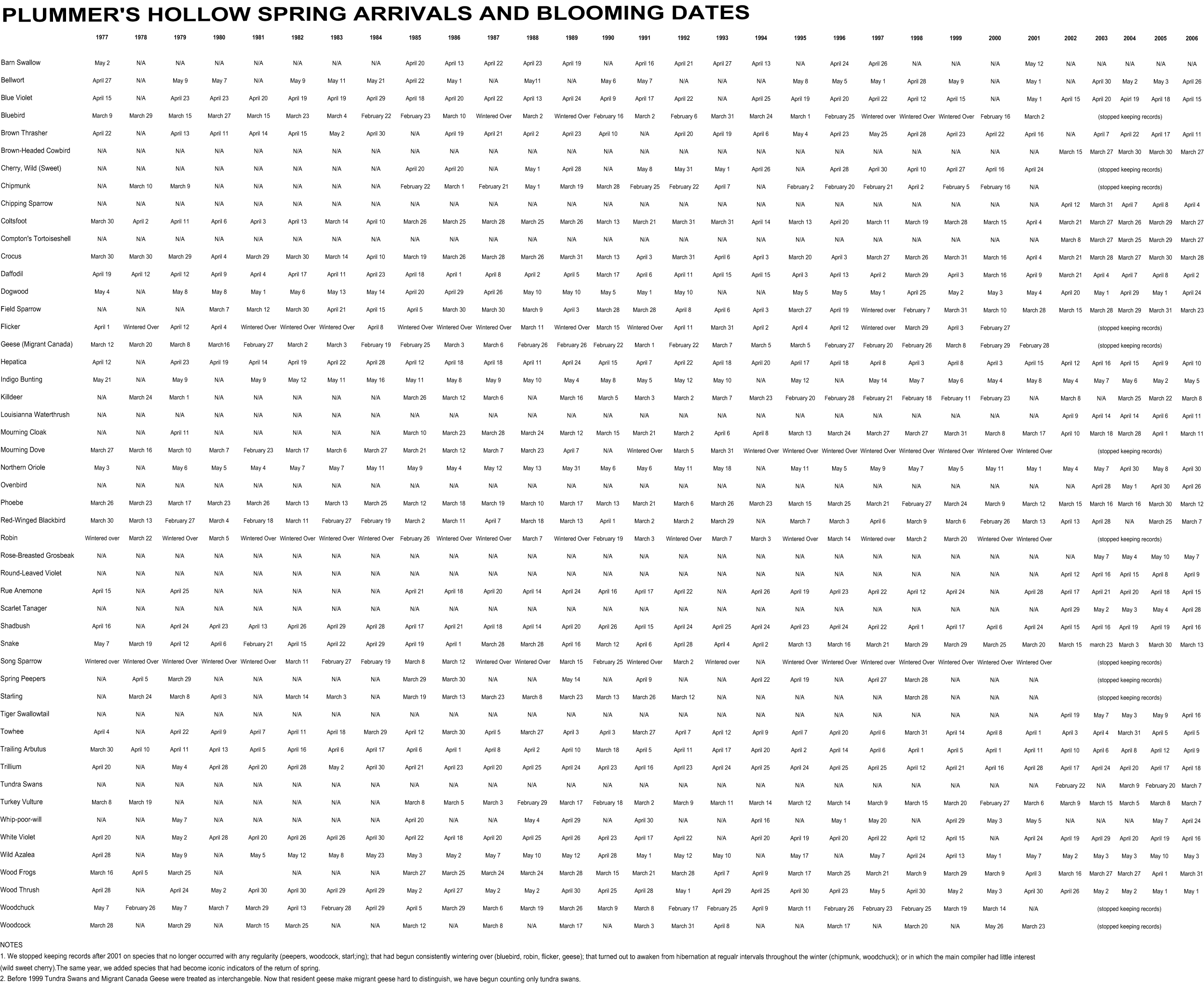
Our first spring arrival — meaning the earliest sighting of something included in our Spring Arrivals and Blooming Dates list — was a turkey vulture that soared right over the house around 12:45 p.m. on February 19. That’s just one day later than our earliest-ever TV, February 18, back in 1991.

A lot of people speak of the equinoxes and solstices as the “official” beginnings of the seasons whose names they bear, but this is nonsense: seasons are purely cultural constructs. The length and number of seasons can vary considerably depending on latitude and microclimate. Many parts of the world only have two seasons, for example — a wet season and a dry season. Moreover, several years ago, I heard one of the Penn State weather gurus on the local public radio station opine that, for our area, based on average temperatures and other indicators, the first day of the month in which an equinox or solstice occurs is generally pretty close to the true beginning of the season. So if I want to believe that the tundra swans’ fluting calls signaled the arrival of spring this morning, who’s to say I’m wrong?

The high today was around 55°F, depending on which thermometer you believe. True, our deepest snowfall of the year — some eight inches — was just two days ago. And if recent years are any guide, we can expect another couple of snows at least before the month is over. But those will be spring snows. The swans have spoken.

–Dave

Signs and marvels

icy shelf fungus

“Ah! A rare sighting of the Lesser Spotted Woodland Jellyfish!” says Hydragenic in a comment on this photo at my Flickr site. He’s right. But rare sightings like this will only become more common as global climate change accelerates and all species, even imaginary ones, find their ecological niches suddenly shifting or disappearing. Here in Pennsylvania, we can expect a lot less snow and a lot more ice in the years to come, with possibly devastating effects on native forest ecosystems.

Last weekend’s ice storm was marvelous: the kind that drops plenty of pellet ice first, providing a nice, granular surface for easy walking, and then just enough freezing rain to make things all glittery — or grotesque, as the case may be — without bringing down any trees. My mother was in heaven, since her poor sense of balance and bad back keep her house-bound after most ice storms, and nothing is quite so frustrating to a naturalist as being confined to quarters. The cold weather held the ice for a day and a half, and hoar frost coated the ice on the morning of the second day. (I have a series of five photos taken that day set to appear at my photoblog, Visual Soma, Feb. 8-12).

Now everything’s melted again after two days of unseasonable warmth, and another cold front has blown in. Unlike many folks to the north and northeast of us, we have yet to receive any dramatic snowfalls this winter, which is bad news for shrews, voles, and other subnivean creatures whose population ecology depends on a couple months of the year to reproduce realtively unmolested by the usual battery of predators.

–Dave

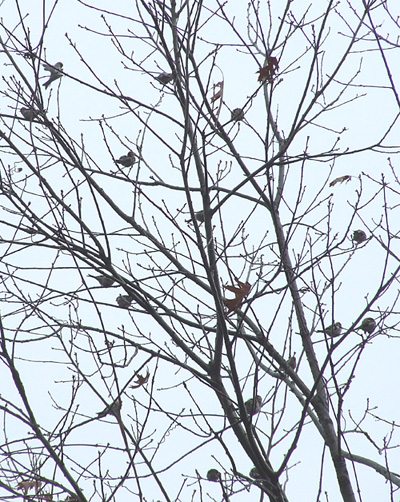
Redpolls at the feeder

common redpoll 1A couple of the redpolls that have been visiting the mountain off and on since December 21 started showing up at the bird feeders yesterday. This male was particularly aggressive this morning, driving all other birds from both sides of the big feeder before settling in to nosh on sunflower seeds. But by early afternoon, he or another male had learned to share the larger of the round feeders, and to forage on the ground with the other birds as well.

This has also so far been a good winter for house finches and goldfinches, both of which have been coming to the feeder in great numbers. We haven’t seen any purple finches since December.

common redpoll 2

Return of the swamp sparrow

Yesterday afternoon, Steve spotted a swamp sparrow in the tiny cattail marsh beside the spring house. Was this the same individual that hung out at the bird feeder for several weeks last April? Is this a sign of a general expansion in range for this species?

In other bird-related news, Lillian and Don Stokes in their birding blog note that the results of this year’s Christmas bird count are showing that “this is a fantastic year for seeing irruptive species of birds. Pine Siskins, Pine Grosbeaks, Common Redpolls and more are being seen widely across the country.” So sometimes unusual sightings here on the mountain, such as the redpolls we saw in December and early January, do reflect larger trends.

Redpolls

common redpolls

We have a flock of common redpolls visiting the mountain for the first time in many years. Mom first sighted them at the edge of the Far Field on December 21, and I spotted them again (and took the above picture) on December 28, along the edge of First Field near the uphill end of the deer exclosure. Both times they were feeding on black birch seeds. That’s a red maple in the photo, though — my attempts to photograph them in the birch had spooked them a little. Still, they are very unwary of humans, since they don’t ordinarily see very many of them in the Artic and Taiga. Their twittery calls are unmistakeably finch-like, but not as high and squeaky as, say, goldfinches.

Redpolls have been spotted all over Pennsylvania this month. They, like the pine siskins that have also been visiting, are one of the so-called irruptive species: birds that usually reside in the north woods, but that shift far to the south on winters when the seed crop fails.

Common Redpolls feed primarily on the catkins produced by birch and alder trees. When catkin production is low, Common Redpolls leave these areas and irrupt into areas where food is more plentiful. Common Redpoll irruptions can be extensive, ranging as far south as the Middle Atlantic States or central Kansas.

Will evening grosbeaks be next?

— Dave

Merry Christmas from Plummer’s Hollow

sleet pine tree

Well, it’s only really a half-white Christmas here — which is to say, the last of the snow that wasn’t washed away by the rain on December 23 covers all the north-facing slopes, very little of the south-facing slopes, and roughly half of everything else. It also turned to ice, making walking very treacherous, as Mom found out yesterday morning when she tried to go for a walk.

I hope we get more snow soon, and I’ve activated the temporary falling-snow feature here on the blog as a form of sympathetic magic. Merry Christmas, y’all.

Two Plummer’s Hollow breeding birds included in Watchlist 2007

Watchlist 2007, a listing of U.S. bird species considered at greatest need of immediate conservation attention, “builds on the species assessments conducted for many years by Partners in Flight (PIF) on landbirds, using those same PIF standards, but expanded to cover species of all taxa. The list is based on the latest available research and assessments from the bird conservation community, along with data from the Christmas Bird Count and Breeding Bird Survey.” The list contains 217 species in all, and is divided into “red” and “yellow” — kind of like a two-tiered version of the Department of Homeland Security’s terrorism alert levels. Two species in the less severely threatened “yellow” category regularly breed in Plummer’s Hollow in sizable numbers, according to data we have gathered for the Pennsylvania Breeding Bird Atlas and in annual point counts for the Bald Eagle Ridge Important Bird Area, which includes this property: the cerulean warbler and the wood thrush. These are two of six Watchlist species found in Pennsylvania, according to an article in the PA Environment Digest.

Wood Thrush: Wood thrushes rely on large interior forests and are threatened by habitat fragmentation, deforestation, and nest parasitism. Each year wood thrushes, down 62 percent in Pennsylvania over the past 40 years, migrate from Central America to the U.S., where Pennsylvania houses 8.5 percent of the world’s breeding population. Audubon Pennsylvania is actively engaging landowners and helping them improve their deer management practices as well as advocating statewide improvement to deer management. A deer herd out of balance with Penn’s Woods hinders healthy forest regeneration and serves as a contributing factor to habitat loss for forest-dwelling species, like the wood thrush, and other wildlife.

Cerulean Warbler: The cerulean warbler is found in the forests of riparian valleys and ridge top habitats in the eastern United States. Over the past half century it has steadily declined in numbers primarily due habitat loss directly associated with numerous types of human activities on both breeding and wintering grounds. In more recent years large areas of both types of breeding habitat have been destroyed through a practice of coal extraction known as mountaintop removal mining. Audubon Pennsylvania supports alternate placement of wind power turbines, many of which are currently sited along ridge tops. Such placement further promotes fragmentation of ridge top habitats utilized by cerulean warblers.

The presence of such interior-forest species, as well as the ridge’s importance as a migratory corridor for raptors (especially golden eagles), were the main reasons for its designation as an Important Bird Area by the Ornithological Technical Committee of the Pennsylvania Biological Survey. Wind turbine installations proposed for Bald Eagle Ridge and many other forested ridges in central and western Pennsylvania would further endanger these already declining species. We have of course refused offers from wind companies to build on our own portion of the ridge, but are just paranoid enough to fear that someday we might face the imposition of eminent domain.