How much carbon does our forest sequester?

locomotiveThe cover story in the current (Spring 2008) issue of OnEarth magazine, called The Giving Trees, includes some important information about the value of intact, mature forests. The author, Sharon Levy, describes something called the eddy flux method of measuring the flows of carbon dioxide and water vapor into and out of forests. Devices mounted on towers in forest stands measure winds and gas exchanges at incredible levels of detail and accuracy.

For anyone who might be a little fuzzy on the chemistry involved here, Levy offers a brief refresher course:

Plants take in CO2 and harness the energy of the sun to drive the chemical reaction that melds carbon with water, producing the substance of stem and leaf and releasing oxygen. When darkness or drought bring this process of photosynthesis to a halt, plants respire, just as humans do. That is, plants breathe in oxygen and exhale CO2. But over the long life span of trees in an undisturbed forest, huge reservoirs of carbon are stored for great stretches of time in the organic matter in soil as well as in living wood.

Most relevant to Plummer’s Hollow, Levy describes measurements of the intake and storage of carbon done at the Harvard Forest, in Petersham, Massachusetts, starting in 1989. The stand that scientists measured, predominantly an oak-maple forest, had been flattened by a hurricane in 1938. In the first year of the study, the 50-year-old forest was absorbing 0.8 tons of carbon per acre per year.

Previous calculations by ecologists had suggested that a forest of that age should be reaching its maximum ability to absorb carbon, but measurements at the Harvard Forest 15 years later showed that the rate of carbon sequestration had doubled. In other words, a 65-year-old forest absorbed 1.6 tons of carbon per acre per year. Other studies suggest that much older forests may continue to store carbon as they age — the older the trees, probably, the more and more carbon they store.

The idea the author is driving at is that there may be some very convincing arguments, in addition to familiar ones about wildlife habitat and water conservation, for preserving a lot of forest lands uncut. Older forests help in the fight against global warming.

The Harvard Forest is of course not Plummer’s Hollow, but we also own a mostly oak-maple forest. Excluding about 80 acres out of our 650 acres of land, where a savage cutting was performed 16 years ago before we could buy it, and excluding another 70 acres of recent blowdowns, open meadows, talus slopes, and places that have been selectively logged in the last 30 years, we still have at least 500 acres of forest ranging from 80 to 120 years old.

A 15- to 20-acre section of Laurel Ridge inside and above the large deer exclosure is closer to 200 years old, but much of the remaining 500 acres was last cut in the late 19th or very early 20th centuries. Thus, if the comparison to the Harvard Forest is roughly valid, I would speculate that the forest land in Plummer’s Hollow may be capturing 800 tons of carbon per year, and perhaps quite a bit more.

But other than showing that the property captures so many tons of carbon per year, how does this stack up against the amount of carbon we as a family contribute to the atmosphere through our annual activities? A variety of websites provide simple calculators so people can input data relating to their daily lives — home heating, transportation, consumption of goods — and get an estimate of how much carbon they contribute to the global atmospheric problem.

Ignoring the carbon footprint of the Guest House and its occupant, but including our one jet flight this year, the Carbon Footprint Calculator adds together a variety of estimates and comes up with a figure of 14.134 tons per year. The calculator provided by the Nature Conservancy returns a figure of 42 tons of carbon per year. A third calculator shows that we contribute 10.2 tons per year. Averaging those three calculations we come up with 22 tons per year.

The conclusion: our (mostly) healthy, moderately old, primarily hardwood forest offsets the carbon footprint of roughly 36.3 households with a reasonably low-consumption lifestyle like ours. Or to express it another way, we could live 25 times more extravagantly, wasting resources wildly, and still be net savers of carbon simply by preserving our private forest from being logged.

Not to sound greedy, but if state and federal governments are serious about combating global warming, perhaps forest landowners should get tax credits for not cutting their woods, comparable to the subsidies long enjoyed by farmers who enroll arable land in the Conservation Reserve Program.

— Bruce Bonta

Spring is here (more or less)

I heard tundra swans high overhead first thing this morning — our first of the year. Later in the morning , high, north-bound Vs of Canada geese were presumed to be migrants, as well. Steve saw a ring-billed gull fly over the hollow, too.

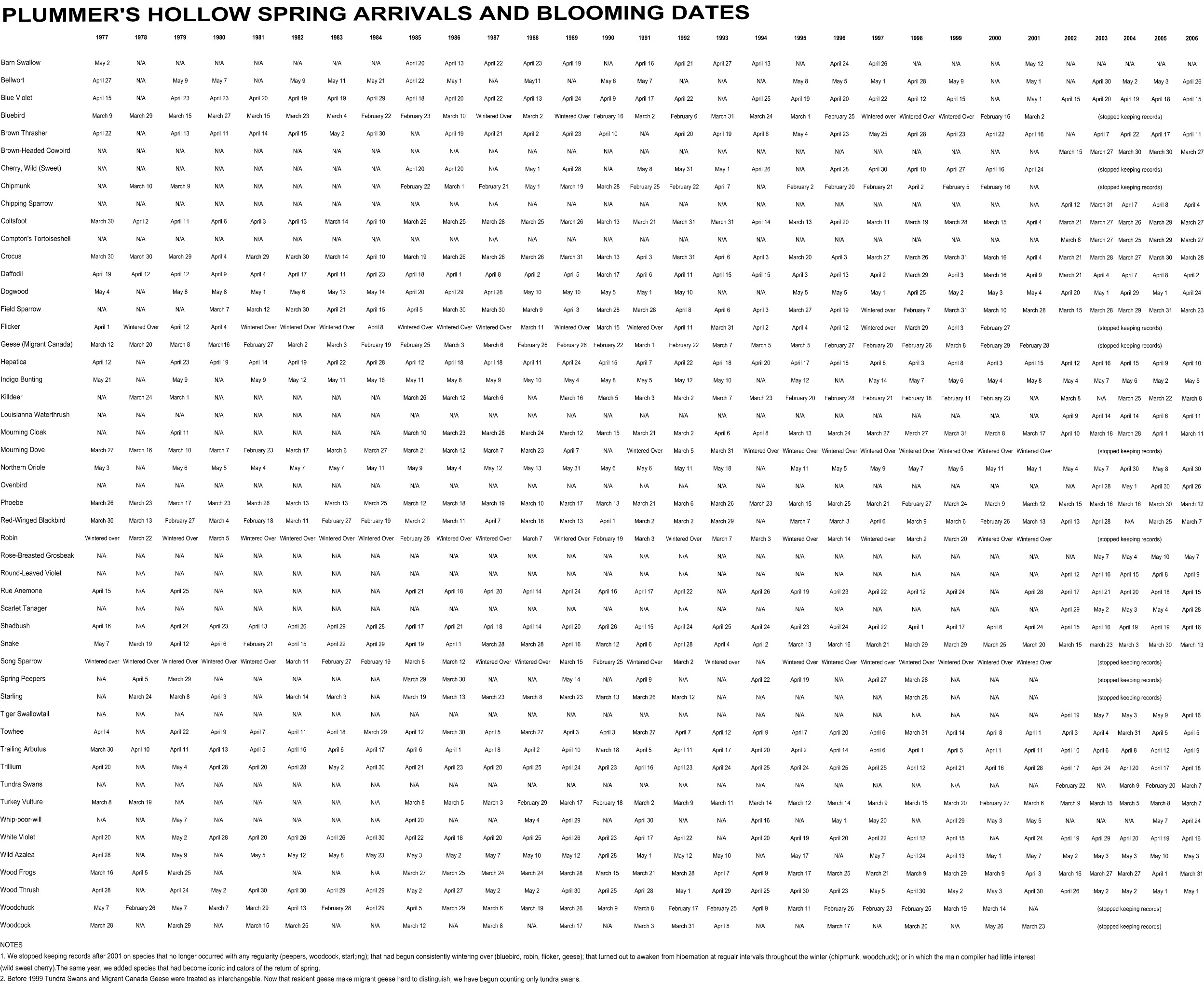
Our first spring arrival — meaning the earliest sighting of something included in our Spring Arrivals and Blooming Dates list — was a turkey vulture that soared right over the house around 12:45 p.m. on February 19. That’s just one day later than our earliest-ever TV, February 18, back in 1991.

A lot of people speak of the equinoxes and solstices as the “official” beginnings of the seasons whose names they bear, but this is nonsense: seasons are purely cultural constructs. The length and number of seasons can vary considerably depending on latitude and microclimate. Many parts of the world only have two seasons, for example — a wet season and a dry season. Moreover, several years ago, I heard one of the Penn State weather gurus on the local public radio station opine that, for our area, based on average temperatures and other indicators, the first day of the month in which an equinox or solstice occurs is generally pretty close to the true beginning of the season. So if I want to believe that the tundra swans’ fluting calls signaled the arrival of spring this morning, who’s to say I’m wrong?

The high today was around 55°F, depending on which thermometer you believe. True, our deepest snowfall of the year — some eight inches — was just two days ago. And if recent years are any guide, we can expect another couple of snows at least before the month is over. But those will be spring snows. The swans have spoken.

–Dave

Signs and marvels

icy shelf fungus

“Ah! A rare sighting of the Lesser Spotted Woodland Jellyfish!” says Hydragenic in a comment on this photo at my Flickr site. He’s right. But rare sightings like this will only become more common as global climate change accelerates and all species, even imaginary ones, find their ecological niches suddenly shifting or disappearing. Here in Pennsylvania, we can expect a lot less snow and a lot more ice in the years to come, with possibly devastating effects on native forest ecosystems.

Last weekend’s ice storm was marvelous: the kind that drops plenty of pellet ice first, providing a nice, granular surface for easy walking, and then just enough freezing rain to make things all glittery — or grotesque, as the case may be — without bringing down any trees. My mother was in heaven, since her poor sense of balance and bad back keep her house-bound after most ice storms, and nothing is quite so frustrating to a naturalist as being confined to quarters. The cold weather held the ice for a day and a half, and hoar frost coated the ice on the morning of the second day. (I have a series of five photos taken that day set to appear at my photoblog, Visual Soma, Feb. 8-12).

Now everything’s melted again after two days of unseasonable warmth, and another cold front has blown in. Unlike many folks to the north and northeast of us, we have yet to receive any dramatic snowfalls this winter, which is bad news for shrews, voles, and other subnivean creatures whose population ecology depends on a couple months of the year to reproduce realtively unmolested by the usual battery of predators.

–Dave

Redpolls at the feeder

common redpoll 1A couple of the redpolls that have been visiting the mountain off and on since December 21 started showing up at the bird feeders yesterday. This male was particularly aggressive this morning, driving all other birds from both sides of the big feeder before settling in to nosh on sunflower seeds. But by early afternoon, he or another male had learned to share the larger of the round feeders, and to forage on the ground with the other birds as well.

This has also so far been a good winter for house finches and goldfinches, both of which have been coming to the feeder in great numbers. We haven’t seen any purple finches since December.

common redpoll 2

Return of the swamp sparrow

Yesterday afternoon, Steve spotted a swamp sparrow in the tiny cattail marsh beside the spring house. Was this the same individual that hung out at the bird feeder for several weeks last April? Is this a sign of a general expansion in range for this species?

In other bird-related news, Lillian and Don Stokes in their birding blog note that the results of this year’s Christmas bird count are showing that “this is a fantastic year for seeing irruptive species of birds. Pine Siskins, Pine Grosbeaks, Common Redpolls and more are being seen widely across the country.” So sometimes unusual sightings here on the mountain, such as the redpolls we saw in December and early January, do reflect larger trends.

Redpolls

common redpolls

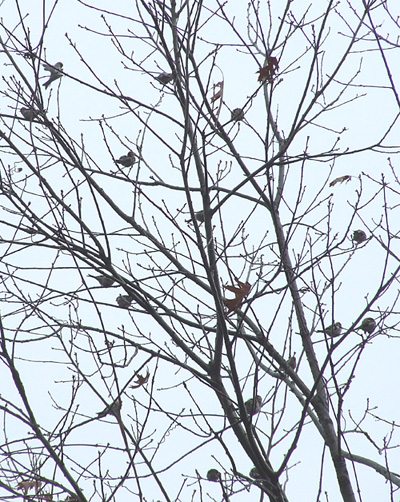
We have a flock of common redpolls visiting the mountain for the first time in many years. Mom first sighted them at the edge of the Far Field on December 21, and I spotted them again (and took the above picture) on December 28, along the edge of First Field near the uphill end of the deer exclosure. Both times they were feeding on black birch seeds. That’s a red maple in the photo, though — my attempts to photograph them in the birch had spooked them a little. Still, they are very unwary of humans, since they don’t ordinarily see very many of them in the Artic and Taiga. Their twittery calls are unmistakeably finch-like, but not as high and squeaky as, say, goldfinches.

Redpolls have been spotted all over Pennsylvania this month. They, like the pine siskins that have also been visiting, are one of the so-called irruptive species: birds that usually reside in the north woods, but that shift far to the south on winters when the seed crop fails.

Common Redpolls feed primarily on the catkins produced by birch and alder trees. When catkin production is low, Common Redpolls leave these areas and irrupt into areas where food is more plentiful. Common Redpoll irruptions can be extensive, ranging as far south as the Middle Atlantic States or central Kansas.

Will evening grosbeaks be next?

— Dave

Merry Christmas from Plummer’s Hollow

sleet pine tree

Well, it’s only really a half-white Christmas here — which is to say, the last of the snow that wasn’t washed away by the rain on December 23 covers all the north-facing slopes, very little of the south-facing slopes, and roughly half of everything else. It also turned to ice, making walking very treacherous, as Mom found out yesterday morning when she tried to go for a walk.

I hope we get more snow soon, and I’ve activated the temporary falling-snow feature here on the blog as a form of sympathetic magic. Merry Christmas, y’all.