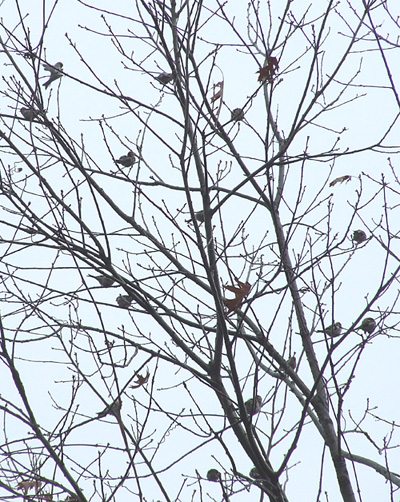
2008 International Migratory Bird Day

indigo bunting in the rainIt was 46 degrees and raining when I awoke at 6:00 a.m., but the birds sang anyway, especially the two male Baltimore orioles competing for a female in our yard. I managed to count 19 species from our veranda and front porch before breakfast, including an eastern kingbird that had first appeared at the edge of First Field on Thursday. Later in the morning, carrying an umbrella, trying to protect my binoculars from the rain, keeping my feet dry, and staying warm, all while counting birds, was no fun. However, I added 15 more species to my list, including many singing indigo buntings in the field and wood thrushes in the woods. Worm-eating warblers, ovenbirds, black-throated green warblers, hooded warblers and even a black-throated blue warbler also sang. About the only birds I saw were those in the fields. The rest I counted by ear.

After a rest and a change into dry clothes and boots, I went more happily out in the sunny afternoon. Down our road I walked to get Acadian flycatchers and common grackles. Then I climbed up to the former clearcut where I hit the jackpot — a migratory flock of warblers that included many American redstarts. I also heard both a cerulean warbler and a northern parula. By the time I reached home, at 5:30 p.m., I had 55 species — a respectable total for a solo performance. Then, after dinner, I looked at my mertensia patch for a ruby-throated hummingbird and there he was. And, right on schedule, our resident whippoorwill called outside at 8:45 p.m. As usual, the eastern towhees (13) and red-eyed vireos (12) were the most abundant species or at least singers. Hooded warblers won the warbler contest at eight, closely followed by American redstart (7). Wood thrushes (8) scarlet tanagers (8) and indigo buntings (7) also made a good showing, and I did have many wonderful sightings of the tanagers and buntings.

© Marcia Bonta

Compare last year’s IMBD report.

Redpolls at the feeder

common redpoll 1A couple of the redpolls that have been visiting the mountain off and on since December 21 started showing up at the bird feeders yesterday. This male was particularly aggressive this morning, driving all other birds from both sides of the big feeder before settling in to nosh on sunflower seeds. But by early afternoon, he or another male had learned to share the larger of the round feeders, and to forage on the ground with the other birds as well.

This has also so far been a good winter for house finches and goldfinches, both of which have been coming to the feeder in great numbers. We haven’t seen any purple finches since December.

common redpoll 2

Return of the swamp sparrow

Yesterday afternoon, Steve spotted a swamp sparrow in the tiny cattail marsh beside the spring house. Was this the same individual that hung out at the bird feeder for several weeks last April? Is this a sign of a general expansion in range for this species?

In other bird-related news, Lillian and Don Stokes in their birding blog note that the results of this year’s Christmas bird count are showing that “this is a fantastic year for seeing irruptive species of birds. Pine Siskins, Pine Grosbeaks, Common Redpolls and more are being seen widely across the country.” So sometimes unusual sightings here on the mountain, such as the redpolls we saw in December and early January, do reflect larger trends.

Redpolls

common redpolls

We have a flock of common redpolls visiting the mountain for the first time in many years. Mom first sighted them at the edge of the Far Field on December 21, and I spotted them again (and took the above picture) on December 28, along the edge of First Field near the uphill end of the deer exclosure. Both times they were feeding on black birch seeds. That’s a red maple in the photo, though — my attempts to photograph them in the birch had spooked them a little. Still, they are very unwary of humans, since they don’t ordinarily see very many of them in the Artic and Taiga. Their twittery calls are unmistakeably finch-like, but not as high and squeaky as, say, goldfinches.

Redpolls have been spotted all over Pennsylvania this month. They, like the pine siskins that have also been visiting, are one of the so-called irruptive species: birds that usually reside in the north woods, but that shift far to the south on winters when the seed crop fails.

Common Redpolls feed primarily on the catkins produced by birch and alder trees. When catkin production is low, Common Redpolls leave these areas and irrupt into areas where food is more plentiful. Common Redpoll irruptions can be extensive, ranging as far south as the Middle Atlantic States or central Kansas.

Will evening grosbeaks be next?

— Dave

Christmas Bird Count 2007

pine siskin and house finch

(From Marcia’s journal)

December 15, 2007
22 degrees and a rosy-fingered dawn as I headed outside. Two common ravens flew above Sapsucker Ridge. Surely they were a sign of great sightings to come. Our resident red-bellied woodpecker drum-rolled as I set out. The sun was engulfed in clouds, but occasionally a shaft of sunlight appeared.

The crunching of the icy snow beneath my feet made it almost impossible to hear any birds as I walked up First Field. Still, I detected a cardinal-like chip and crunched over to the woods. After a few quiet moments, three female cardinals flew into a grapevine and ate. A couple black-capped chickadees and tufted titmice also appeared. And on Sapsucker Ridge, a Carolina wren sang.

Then I heard nothing until I rounded the first bend on the Far Field Road and five robins flew overhead calling. One landed briefly so I had a good look at it through my binoculars.

Sitting on Coyote Bench, I soaked in the sunshine and silence, but no birds called or appeared.

I went on to a silent Far Field. Only at the Second Thicket did I pick up cardinals, a crow, ruffed grouse and blue jay. But I heard the red-tail call that I heard there yesterday and as I descended the thicket an immature red-tail flew off from a tree. I also saw a few white-throated sparrows and dark-eyed juncos.

I decided to push on to the hunting lodge on a neighboring property. It was a lovely hike, but except for a few chickadees, nothing stirred even in the hedgerows. The weather held, but still the birds were scarce. Until I reached the Second Thicket area again, I saw no birds. Then I pished up more white-throated sparrows, a winter wren, a singing Carolina wren and an American tree sparrow.

On my way back home along Sapsucker Ridge Trail, I heard one hairy woodpecker and spotted the female hairy I had seen the previous day on the same tree. Altogether, I walked six miles to record 17 species, eight of which also appeared at our feeders. Back at the house, Dave had set up his camera and tripod at the kitchen window to photograph birds while baking bread and showed me a couple shots he had taken of a pine siskin.

Steve was on the cellphone down on Waterthrush Bench in the hollow, as frustrated as I had been by the lack of birds in the sheltered, south-facing thickets of Sapsucker Ridge. Still, he had found a yellow-bellied sapsucker. And he persisted through most of the afternoon, adding more species and numbers.

I needed to bake a blueberry crumb pie after lunch for the Bird Count supper at the Hoyers’, so I turned on the Metropolitan Opera and listened to Gounod’s Romeo and Juliet in between baking and keeping a stake-out on the feeders all afternoon, adding more numbers to most of the feeder birds, and finally seeing a song sparrow there near dusk. Once I spotted a large bird on a fallen tree in the flat area that turned out to be a common flicker. Still, I didn’t add one species to Steve’s list. Altogether, I had 22 species, Dave’s siskin made 23, and Steve added 10 more species — 33 in all.

Later, when we returned from the Bird Count supper, we found a message on our answering machine from Troy Scott, who reported counting 26 wild turkeys at the base of the mountain.

CHRISTMAS BIRD COUNT LIST

1. Red-tailed hawk — 2

2. Sharp-shinned hawk — 1

3. Canada goose — 45

4. Mallard — 10

5. Red-bellied woodpecker — 8

6. Common flicker — 3

7. Hairy woodpecker — 2

8. Downy woodpecker — 7

9. Yellow-bellied sapsucker — 1

10. Blue jay — 5

11. American crow — 8

12. Common raven — 3

13. Black-capped chickadee — 30

14. Tufted titmouse — 13

15. White-breasted nuthatch — 11

16. Brown creeper — 2

17. Golden-crowned kinglet — 6

18. Northern cardinal — 12

19. American goldfinch — 15

20. Pine siskin — 1

21. Ruffed grouse — 8

22. White-throated sparrow — 30

23. American tree sparrow — 11

24. Dark-eyed junco — 82

25. Song sparrow — 2

26. American robin — 54

27. House finch — 24

28. European starling — 162

29. Carolina wren — 7

30. Winter wren — 2

31. Rock dove — 5

32. Northern harrier — 1

33. Mourning dove — 4

34. Wild turkey — 26

© 2007 Marcia Bonta
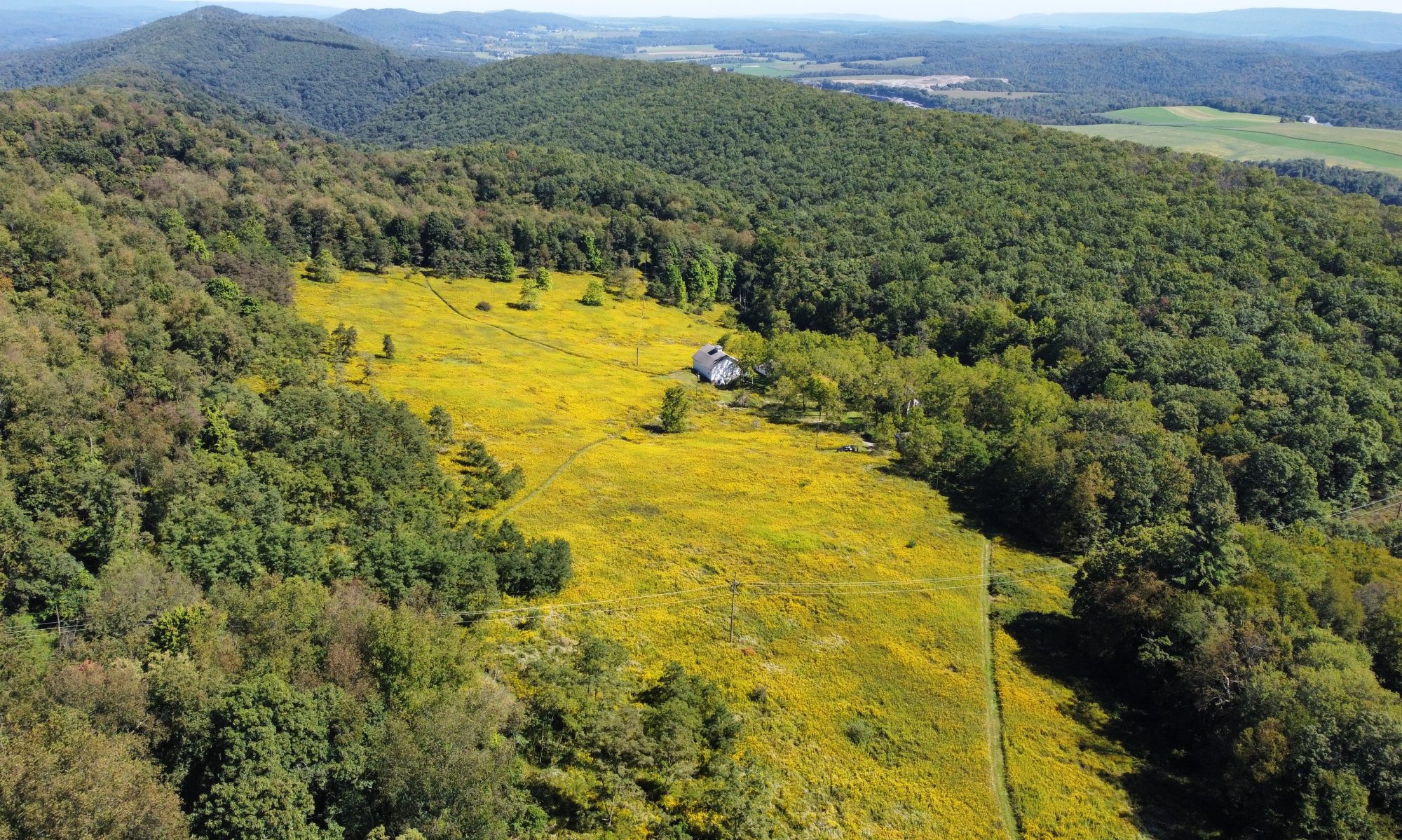
Two Plummer’s Hollow breeding birds included in Watchlist 2007

Watchlist 2007, a listing of U.S. bird species considered at greatest need of immediate conservation attention, “builds on the species assessments conducted for many years by Partners in Flight (PIF) on landbirds, using those same PIF standards, but expanded to cover species of all taxa. The list is based on the latest available research and assessments from the bird conservation community, along with data from the Christmas Bird Count and Breeding Bird Survey.” The list contains 217 species in all, and is divided into “red” and “yellow” — kind of like a two-tiered version of the Department of Homeland Security’s terrorism alert levels. Two species in the less severely threatened “yellow” category regularly breed in Plummer’s Hollow in sizable numbers, according to data we have gathered for the Pennsylvania Breeding Bird Atlas and in annual point counts for the Bald Eagle Ridge Important Bird Area, which includes this property: the cerulean warbler and the wood thrush. These are two of six Watchlist species found in Pennsylvania, according to an article in the PA Environment Digest.

Wood Thrush: Wood thrushes rely on large interior forests and are threatened by habitat fragmentation, deforestation, and nest parasitism. Each year wood thrushes, down 62 percent in Pennsylvania over the past 40 years, migrate from Central America to the U.S., where Pennsylvania houses 8.5 percent of the world’s breeding population. Audubon Pennsylvania is actively engaging landowners and helping them improve their deer management practices as well as advocating statewide improvement to deer management. A deer herd out of balance with Penn’s Woods hinders healthy forest regeneration and serves as a contributing factor to habitat loss for forest-dwelling species, like the wood thrush, and other wildlife.

Cerulean Warbler: The cerulean warbler is found in the forests of riparian valleys and ridge top habitats in the eastern United States. Over the past half century it has steadily declined in numbers primarily due habitat loss directly associated with numerous types of human activities on both breeding and wintering grounds. In more recent years large areas of both types of breeding habitat have been destroyed through a practice of coal extraction known as mountaintop removal mining. Audubon Pennsylvania supports alternate placement of wind power turbines, many of which are currently sited along ridge tops. Such placement further promotes fragmentation of ridge top habitats utilized by cerulean warblers.

The presence of such interior-forest species, as well as the ridge’s importance as a migratory corridor for raptors (especially golden eagles), were the main reasons for its designation as an Important Bird Area by the Ornithological Technical Committee of the Pennsylvania Biological Survey. Wind turbine installations proposed for Bald Eagle Ridge and many other forested ridges in central and western Pennsylvania would further endanger these already declining species. We have of course refused offers from wind companies to build on our own portion of the ridge, but are just paranoid enough to fear that someday we might face the imposition of eminent domain.

Clash of the seasons

aspens in snow

Our first snowstorm of the year yesterday brought two inches of wet stuff. That in itself might not be cause for comment, except for the fact that our oaks only reached their peak of color a few days ago, and many of the maples still hold their leaves, too. The preponderance of oaks among the canopy-height trees here is a bit of an anomaly; elsewhere in the area, the colors have mostly faded. So our autumn is a little later than the norm, perhaps.

red oak sapling in snowTwo inches is just enough to make everything pretty, but not enough to start breaking limbs — a real concern this time of year. Only three years ago, a mid-November ice-storm did a heavy pruning on many of the oaks. And too much wet snow when the ground is still unfrozen can fell trees, as happened here back in December 1992.

This morning, we had four finch species at the feeders: house finch, purple finch, goldfinch and pine siskin — good-sized flocks of the latter two. Mom has high hopes for a winter-finch irruption year. It would be our first in over a decade, if it happens.

To see all of yesterday’s photos, visit the date archive at my Flickr site.