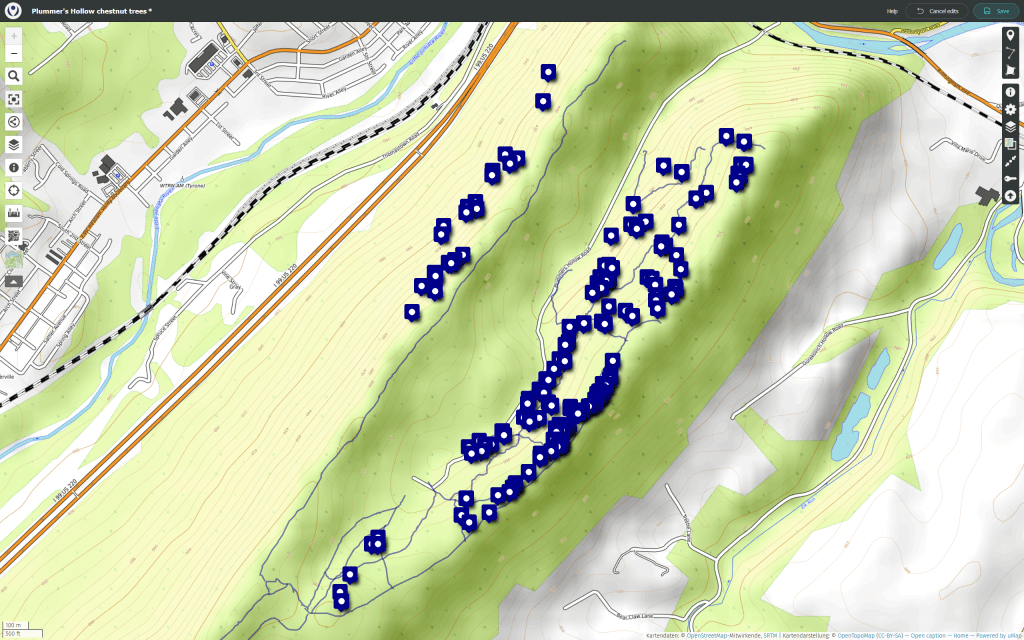
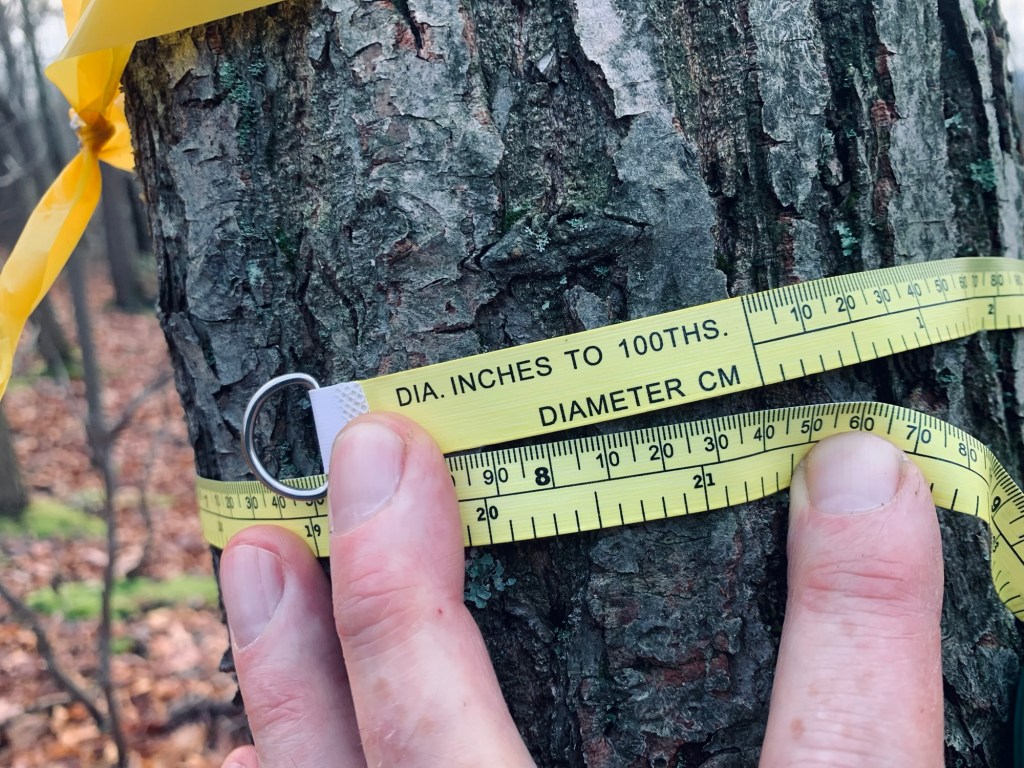
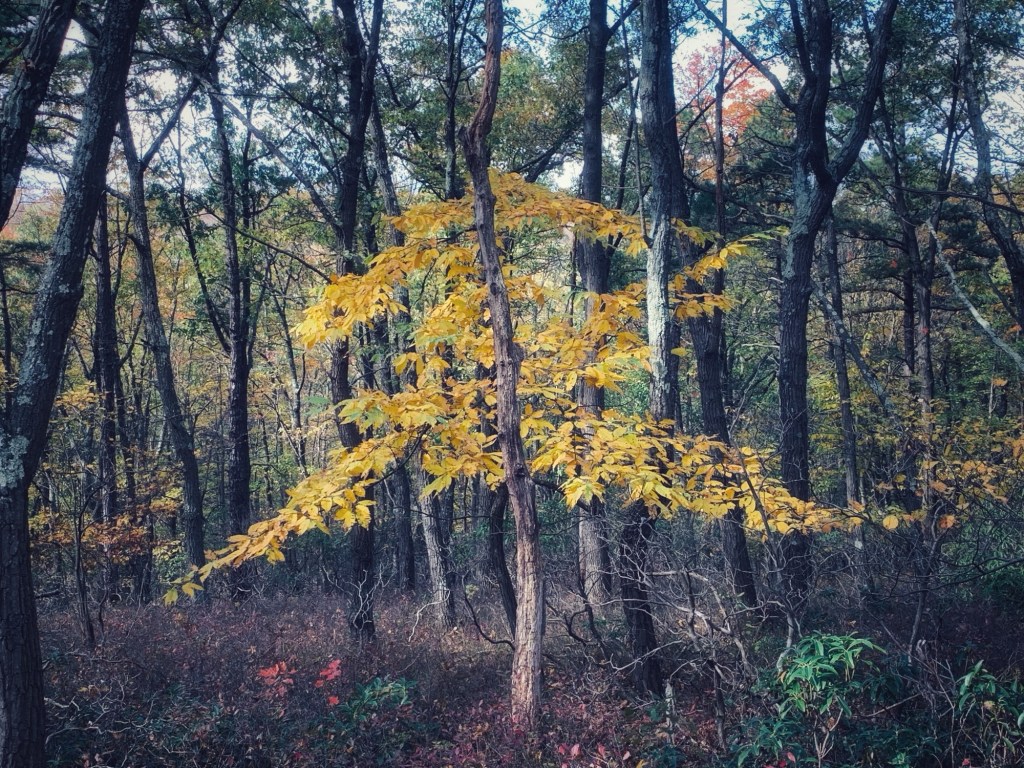
One hundred and fifty-two. That’s how many American chestnuts I was able to locate this autumn on our square mile of mountaintop land, after extensive wandering about the oak-heath forest on Laurel Ridge, their main stronghold, as well as the northwest-facing slope of Sapsucker Ridge, where a smaller scattering remains. I initially tagged each tree, sprout, or (in one or two possible cases) seedling with yellow surveyor’s ribbon, then came back after all the leaves were down to record a bit of data about each one: diameter at breast height, estimated height of tree, whether it’s on the way out, and if so, whether it has any basal sprouts poised to take over.
At present I’m using a free app on my phone, Avenza Maps, to record the data. A friend of Eric’s from the American Chestnut Foundation is interested in doing some genetic analysis, and we’ll see what comes from that. It’s possible that a few might actually be Castanea pumila — Allegheny chinquapin or dwarf chestnut, which is also affected by the blight. Many of them are quite tall, however, so I’m assuming that the vast majority are Castanea dentata, though they do also hybridize.
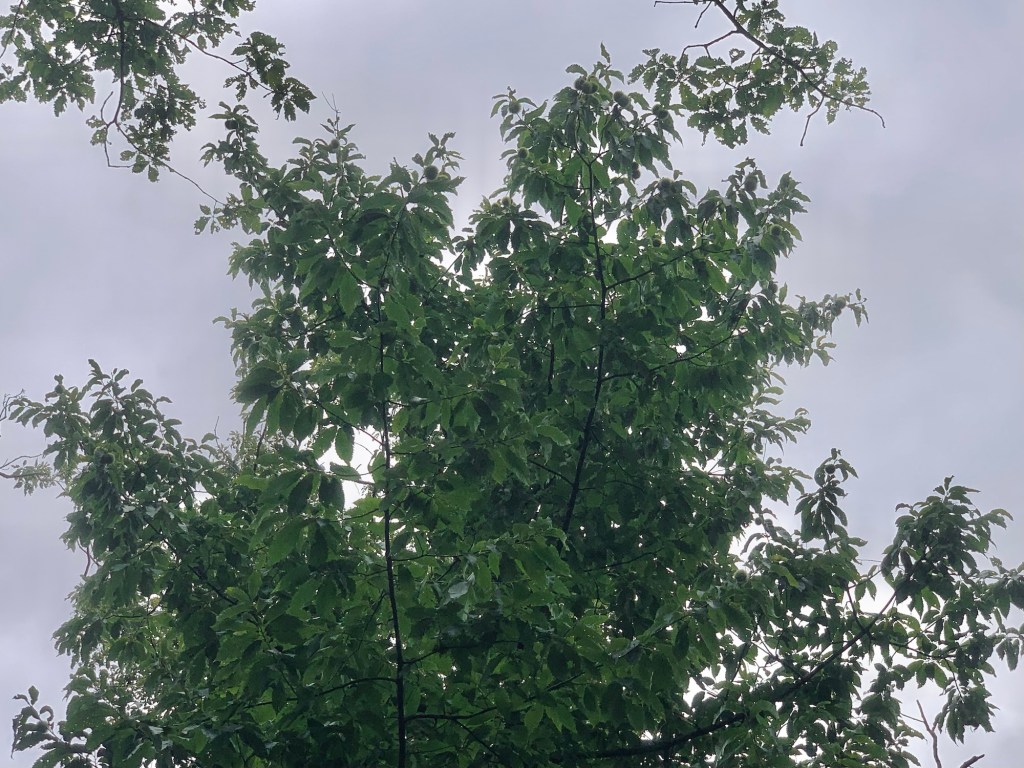
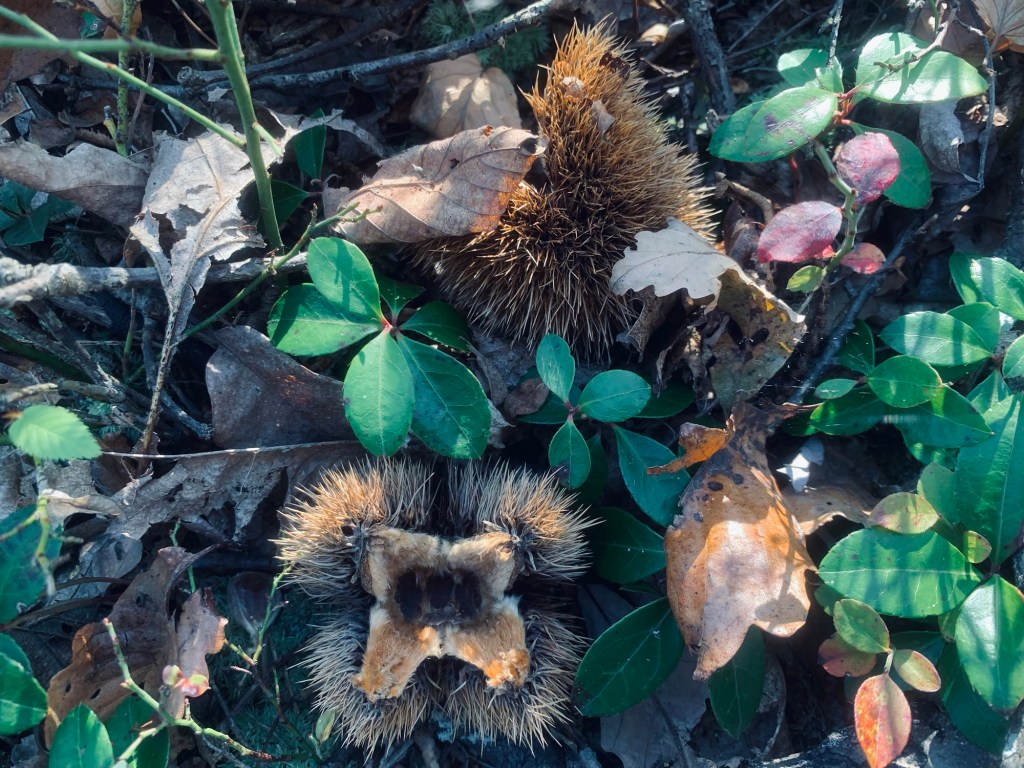
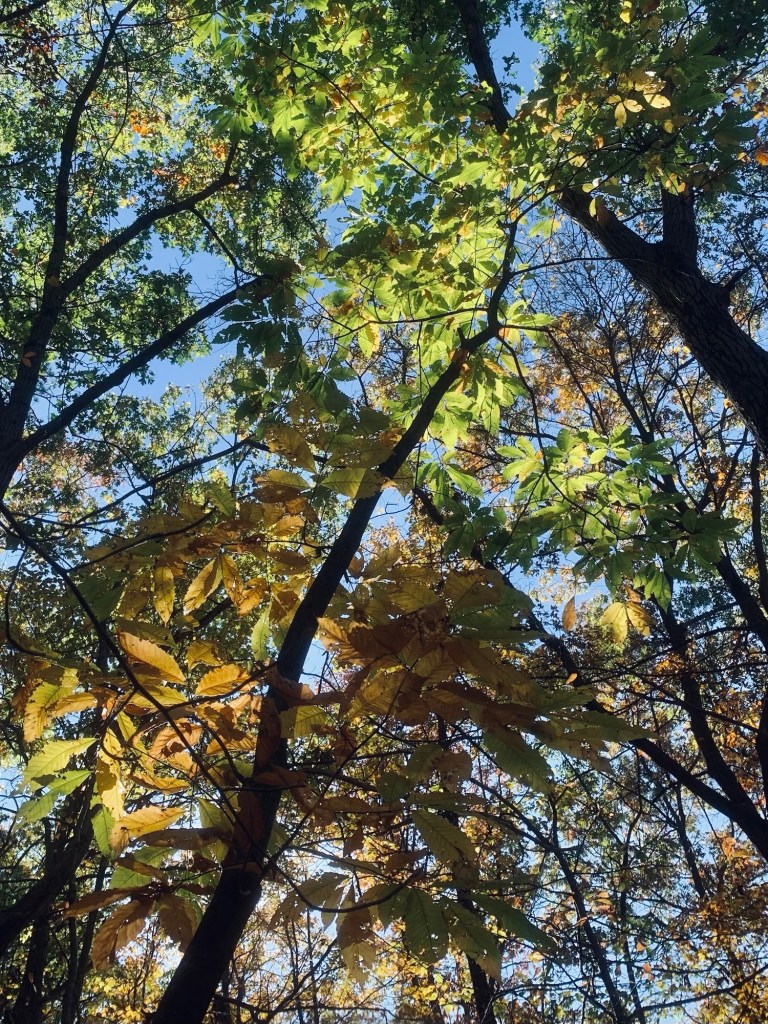
The biggest American chestnut on our end of the mountain is just over the line with a neighbor, and was the only one to bear nuts this year. It came in at 8.7 inches dbh (diameter at breast height, which is standardized at 4.5 feet) and is about 75 feet tall—canopy height where it’s growing. The largest on our own property is 8.4″ dbh and about 70 feet tall, just north of the ridge crest near the end of Laurel Ridge. In second place is one conveniently located adjacent to Laurel Ridge Trail: 7.9″ dbh, ~75 feet tall. Three more are over six inches in diameter, seven more are over five inches, 19 more are over four inches, 35 over 3 inches, and all the rest (80+) smaller than that. I took note of which ones were nearly dead with just one or two, badly deer-browsed sprouts: those will be candidates for deer fencing.
I’m sorry I didn’t start keeping records years ago, but better late than never. I just felt the need to better understand what trees (of various species) we have and how they’re doing in this time of fluctuating deer populations and new invasive species, pests and blights. It’s been heartbreaking to see the nemotode-caused beech leaf disease come into the hollow, bringing the very real possibility that all our lovely old American beeches will die, just as our white ashes have all been killed by the emerald ash borer, the butternut trees have all succumbed to butternut canker, and the wooly adelgid continues its slow decimation of the eastern hemlocks.
The spongy moth (formerly Gypsy moth), though controlled a bit by a virus and fungus now, can still do considerable damage to oaks, especially in combination with late freezes, which are a lot more common in recent years due to global weirding. This is however good news for some of the chestnuts, since canopy openings due to dead oaks may allow more Castanea trees to flower, ennabling cross-fertilization by their insect pollinators, and thereby maybe someday allowing the species to evolve resistance to the blight.
And that’s our primary management goal for chestnuts: to give them the maximum opportunity to evolve resistance—the work of centuries, most likely. So it seemed imperative to start keeping track of them, see whether their numbers are increasing, declining, or remaining about the same, and keep an eye out for possible new sprouts from the nuts these hoary old warriors are still able to produce, once in a while.
I’m not entirely sure where this project goes from here. If anyone has any thoughts or suggestions, leave a comment or otherwise get in touch. As a poet with dyscalculia, I’m not necessarily cut out for doing science, but I do love a good excuse to wander around in the woods, so I’m definitely planning more surveys of some of the rarer trees and shrubs, and possibly other landscape features such as old charcoal hearths. Mapping is not only fun, but can reveal patterns that are hard to see otherwise. The chestnut project showed what we’d always known based on casual observation, that the trees are concentrated on the ridgetops, but I was surprised at just how many grow on the lower slopes. And they clearly avoid the less acidic soil of the Juniata Formation in favor of its flanking Bald Eagle and Tuscarora formations. The relative few in the latter, on Sapsucker Ridge, either grow among the dense blueberry and huckleberry bushes flanking the open rock slopes—which provide plenty of sunlight for flowering—or on steep slopes, where deer don’t browse as much as on the ridgetop. Laurel Ridge, by contrast, has a much denser understory to protect the sprouts until they get past deer browse height (5-6 feet).
In any case, keeping the deer numbers as low as possible seems key to their long-term survival, so best of luck to all the hunters out there.
a red admiral, placed here to suggest something nebulous about the butterfly effect or whatever
My dad and I were always a bit suspicious of the managerial mindset, which often seems to militate against the kind of humility we thought essential to true ecological understanding. Back when he and Mom got their forest stewardship training in the early 1990s, the main focus was on landowner goals and desires, to which Dad would always respond, wouldn’t it be more interesting to find out what the land wants?
Pennsylvania’s forest stewardship program had been designed by foresters who were convinced that we could have our cake and eat it too, in line with the neoliberal economic thinking then so dominant, which had spawned the oxymoronic paradigm of sustainable growth. Private forest landowners could harvest timber while improving habitat for wildlife, using money from timber sales to pay for various supposed habitat improvements. Suzanne Simard and others were just beginning to discover the ‘wood-wide web’ of micorrhizal fungi, which would eventually reveal just how little even the most well-intentioned foresters had ever understood about the basic hows and whys of forest composition.
We were easy converts for the then-new rewilding movement, adopting a laissez-faire approach to forest stewardship. So much of what then passed for good stewardship involved timbering, and having recently fought loggers to a standstill on the neighboring property in the hollow, and then purchased that property after it was destroyed by logging, Dad was in no mood for more cutting, no matter how worthy the intention. Instead, he talked about managing by not managing. Good luck managing wildlife, he’d say. I manage hunters.
amateur photography has taught me that everything is more interesting in context
Over the ensuing decades it has become so obvious that the least disturbance can create an opening for invasive species, I don’t think many forestry experts would now dispute the ecological perils of logging. Even landowners who don’t care about salamanders or warbler habitat don’t want to see their land so overrun with barberry or autumn olive that they can’t get through it even to hunt. So I think we’ve been vindicated in our opposition to timbering, but not in our preference for passive management, which now seems terribly naive.
The spread of invasive species and devastating new pests and diseases have made it clear that while rewilding can remain a central goal, it’s going to require active management… and we need to step up our invasive control efforts or there won’t be much native habitat left, at which point rewilding becomes meaningless. A feral dog is not the same as a wolf.
But making any sort of detailed plan when the future is so uncertain remains challenging. It seems to require thinking in terms of multiple alternative scenarios: for example, the regional climate is expected to get wetter as well as warmer, but we’d be nuts to not also anticipate forest fires. Thinking about what trees and shrubs to plant or otherwise recover must take into account all their new pests and diseases as best we can, but the ecology is changing so quickly, it’s often impossible to know whether planting a lot of a given species is essential to preserving it, or a fool’s errand that diverts resources from other species that are more likely to hang on. You see the difficulty?
The Healing Mountain
a random sassafras tree on Sapsucker Ridge
Last night, I was discouraged to learn about a new blight affecting sassafras, one of my favorite trees—and not only because I love the taste and drink sassafras tea every day. They’re beautiful looking trees with reddish bark and gnome-like growing habits, they can produce large crops of soft mast of the sort preferring by migrating songbirds, and they often develop hollows for cavity-nesters. I had already made a mental note to myself to include sassafras as a target species for our conservation efforts, along with things like sugar maple, shagbark hickory, American plum, persimmon, and white oak: edible and medicinal species whose presence on the mountain should help preserve the forest, by making it more valuable standing than cut.
I suppose this falls under the heading of seventh-generation thinking. Yes, I know the land is protected by a conservation easement with the Western Pennsylvania Conservancy, but I’m also considering scenarios involving partial or total societal collapse, in which the legal system no longer really functions. These scenarios seem in some ways more likely than blithely assuming that the present system will somehow continue to lurch along.
So the ‘food forest’ paradigm seemed like a good, if partial, fit for us. Local folks already value forests as a source of venison, so there is a cultural predisposition toward a hunter-gatherer mindset. But now I’m thinking it might be better to go with an adjacent concept: instead of a food forest, how about a healing mountain? I like this because it points toward an important truth: as the land heals from its own abuse, it becomes more and more effective as a healing refuge for plants and animals, including humans.
In our language for the conservation easement, we talked about wanting to manage for future old growth in part to preserve local air and water quality, but also for more nebulous aesthetic and spiritual reasons. We want it to be a source of regular regeneration and inspiration for people who live around here. The health benefits of walking are well documented, especially walking in forests, where terpenes released by trees help bolster immune systems. And since it seems that the American healthcare system is going to continue to suck in any likely future, we surely can’t go wrong by emphasizing the medicinal and nutritional properties of native trees, shrubs, vines, fungi and wildflowers.
Of course, every conceptual framework has its drawbacks: foregrounding some things tends to obscure other things. It’s true that I am in much better shape now as a result of regular hikes on the mountain than I was pre-Covid, when I was more sedentary… BUT it’s also important to acknowledge that at this point the mountain might be as dangerous as it is healing, given the increasing prevalence of tick-borne and mosquito-borne diseases such as Lyme and West Nile Virus.
But it does also seem possible that over the next century, if the mountain is actively encouraged to heal from the past 2+ centuries of exploitation, it should become considerably less accommodating to ticks, at least. Possibly there are also native mosquitoes that might be able to out-compete the aggressive invaders carrying the bulk of the new diseases, if given optimal conditions? I live in hope!
Regardless, in general, with biodiversity comes resilience. And as the mountain heals, it should harbor more of the more sought-after medicinal plants, including such things as goldenseal and ginseng. At which point we have to hope whoever owns the land will find a way to prevent a new cycle of exploitation. All the more reason, I suggest, to promulgate this new paradigm of healing mountains. For our new caretaker Eric Oliver, that has become his literal life’s work, learning how to recover native forests on strip-minded mountains, currently as the Pennsylvania coordinator for Green Forests Work. Until very recently, this is something the experts said couldn’t be done.
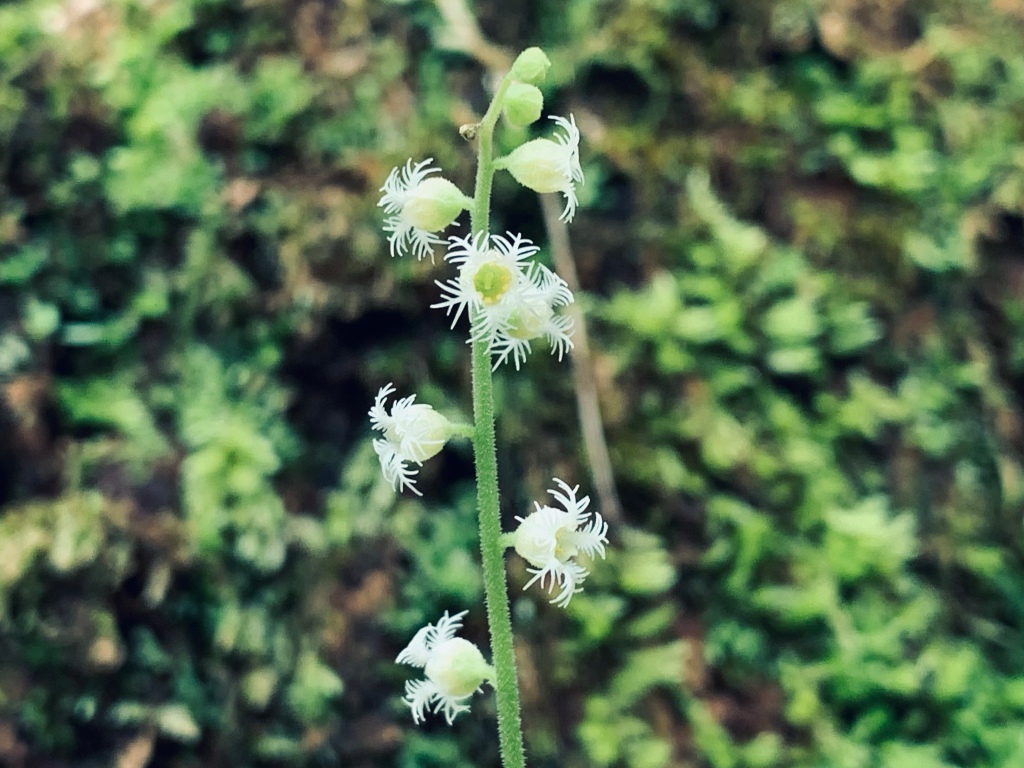
this mitrewort was my reward for walking round a big tulip tree to pull a privet sprout today
During the pandemic, “nature is healing” became an eyeroll-inducing meme, fueled by videos of flocks of goats taking over villages and such, suggesting that all nature really needs is for humans to leave it the hell alone for a while. And that’s a pretty solid instinct. But the success of Eric’s efforts points to a significant continuing role for humans in the natural world. We can each become a healer of sorts, not just walking but noticing, listening, learning, documenting, responding creatively, responding empathetically, learning how and what to weed, to propagate, to nourish or protect. The mountain needs us—at least for now—almost as much as we need the mountain.
Where nature’s concerned, it’s a cliché to say that every year’s different, but that doesn’t stop us from being struck by this simple truth anew each spring. This year in Plummer’s Hollow, certain absences seem especially worthy of note: chipmunk, garlic mustard, and wood thrush numbers are all down dramatically from last year. Our feelings about each decline, however, are quite different.
Chipmunks
chipmunk in Canada mayflowersEastern chipmunk populations follow a several-year boom and bust pattern, and we’re currently in a bust. Last year at this time, you couldn’t walk ten paces in the woods without another chipmunk chittering alarm and diving for cover. This year you’re lucky to see two or three chipmunks per mile. Last Tuesday, a speaker at our local Audubon chapter’s monthly meeting, Dr. Steven Latta from the National Aviary in Pittsburgh, confirmed my suspicion that the chipmunk cycle is tied to the acorn cycle.
Oaks fall into two sub-genus clades: the red oak group of species, which take two years to produce a crop, and the white oak group, which produce acorns every year — barring a crop failure. We have roughly equal numbers of each group on the property. Black, red, and especially scarlet oaks are common on the drier slopes, while chestnut oaks, which are in the white oak group, predominate on the ridgetops. In addition, the Larel Ridge part of the old powerline right-of-way that bisects the upper part of the hollow near the houses has turned into a scrub oak barrens, and scrub oaks are also in the group that masts almost every year — except this past year. Last fall was the off-year for the red oak group, and in addition, the unusually cold and wet conditions during pollination time last May led to a total crop failure of oaks in the white oak group. We didn’t see a single acorn on the mountain. The acorn failure was so widespread in the northeast, it even made the national news.
Dr. Latta’s talk was about Louisiana waterthrushes as indicators of riparian habitat quality, but he mentioned chipmunks in passing: they’re a major nest-predator for ground-dwelling birds, he said, eating the nestlings whenever they find them. (It’s a good bet that ovenbirds, a waterthrush congener also found in the hollow, are heavily impacted by chipmunks during boom years as well.) Latta thought that chipmunk populations in western Pennsylvania, where his study sites are located, probably would’ve crashed this year anyway, due to disease, but he felt that the natually cyclic nature of acorn production by the red oak group is behind the fluctuations in chipmunk numbers.
So this year’s dramatic decline in the chipmunk population is natural then, and therefore nothing to worry about, right? Well, I don’t know. Nothing is ever that simple where ecology is concerned. Oaks are far from the only mast-producing tree or shrub in the woods — if they were, there wouldn’t be any chipmunks right now. As the example of nest predation shows, chipmunks, like squirrels, are resourceful omnivores. Maple and birch seeds may be a far less nutritious substitute for acorns, but they’re plantiful as hell. The dramatic, region-wide increase of black birches and red maples as a percentage of forest cover in recent decades must help cushion chipmunk populations to some extent.
Then there are hickories: once a major component of Appalachian ridgetop forests such as ours, and perhaps again in coming decades as the forests age: hickories are very slow-growing trees. American beech and eastern hemlock, by contrast, will be dropping out of the mast-tree equation as they succumb to an introduced blight and insect pest, respectively. (Beech bark disease has yet to hit Plummer’s hollow, but we figure it’s probably only a matter of time. Most of the mature American beeches in the northern counties of Pensylvania have already died.)
By far the biggest change to our forest in the last hundred years, however, was the almost total loss of the American chestnut due to the devastating effects of the Asian chestnut blight. We do have plenty of sprouts, which occasionally get big enough to flower and bear fruit before succumbing to the blight, and who knows how many more sprouts are eaten by the deer, so it’s safe to say that Plummer’s Hollow must’ve fit the Appalachian mold. A hundred years ago, chestnuts would’ve formed an almost unbroken carpet on the forest floor every year. It will be centuries, probably, before a blight-resistant chestnut re-colonizes the forest, and in the meantime, populations of rodents such as chipmunks, squirrels and mice, and who knows how many other wildlife species, will remain especially vulnerable to acorn crop failure as climate change brings more frequent wet Mays and late frosts.
This is a good example of how ecosystems lose resilience with each decline in biodiversity. In the case of chestnuts, their habit of flowering in June after all frost danger is past made them a more dependable mast species than, for example, the chestnut oaks. And while oaks are wind-pollinated, and therefore especially vulnerable to weather conditions, chestnuts are insect pollinated. My brother Steve and I happened upon a rare grove of flowering American chestnuts in a clearning in a nearby state forest last year, and we were astonished by the number and diversity of long-horned beetles swarming over their fuzzy yellow inflorescences. Steve is a beetle collector who has spent a lot of time in tropical forests, and he said he’d never seen such a concentration of Cerambycidae anywhere. Their numbers on that particular day might have simply been a reflection of the age of the surrounding forest — some ecologists consider long-horned beetle diversity to be an index of forest age, since their larvae live in dead trees. But we found it sobering to realize just what an insect bonanza must have been lost with the functional extirpation of the American chestnut.
Garlic mustard
Garlic mustard is an alien invasive species that first appeared in the hollow some fifteen years ago. It’s uniquely shade-tolerant, allowing it to compete with native wildflowers already under seige throughout the northeast by white-tailed deer. But this year, for the first time, we’ve noticed a decline in the number of flowering garlic mustards. We’re not sure what to attribute this to, and expect that, like the chipmunk decline, it’s only a temporary thing — though we’d love to be wrong about that. I had originally thought that perhaps last spring’s wet weather inhibited pollination, and perhaps it did, but that wouldn’t explain the decline in flowering stalks this year; it’s a biennial.
Like many non-native plants, garlic mustard is invasive because it has escaped the control of whatever insects, herbivores and diseases kept it in check back home (Europe, Asia, and North Africa). It can take a long time for native insects and diseases to adapt to an invasive plant species and rein it in, and in the meantime it can cause all sort of ecological havoc. Here’s how the National Park Service’s Alien Plant Working Group summarizes the case against Alliara petiolata:
Garlic mustard poses a severe threat to native plants and animals in forest communities in much of the eastern and midwestern U.S. Many native widlflowers that complete their life cycles in the springtime (e.g., spring beauty, wild ginger, bloodroot, Dutchman’s breeches, hepatica, toothworts, and trilliums) occur in the same habitat as garlic mustard. Once introduced to an area, garlic mustard outcompetes native plants by aggressively monopolizing light, moisture, nutrients, soil and space. Wildlife species that depend on these early plants for their foliage, pollen, nectar, fruits, seeds and roots, are deprived of these essential food sources when garlic mustard replaces them. Humans are also deprived of the vibrant display of beautiful spring wildflowers.
Garlic mustard also poses a threat to one of our rare native insects, the West Virginia white butterfly (Pieris virginiensis). Several species of spring wildflowers known as “toothworts” (Dentaria), also in the mustard family, are the primary food source for the caterpillar stage of this butterfly. Invasions of garlic mustard are causing local extirpations of the toothworts, and chemicals in garlic mustard appear to be toxic to the eggs of the butterfly, as evidenced by their failure to hatch when laid on garlic mustard plants.
So in this case, we’d love the current decline to turn into a long-term trend, but we suspect that it’s really only a temporary set-back.
Wood thrush
a wood thrush, slightly stunned by a collision with a window
Where wood thrushes are concerned, however, I’m afraid this year’s virtual absence of singing thrushes in the woods near the houses, while probably in part incidental to where territory boundaries happen to have fallen this year, actually is part of a long-term decline — and one which, in contrast with garlic mustard, we do not welcome. Their ethereal, elegiac-sounding calls at dawn and dusk, from May through July, are something I look forward to all winter long, so it’s very sad to think that we may never again experience a woods ringing with thrush song as we did back in the 1970s.
One July evening, along the Short Circuit Trail, I counted three wood thrushes singing at the same time, each song coming from a different direction. On other summer evenings my walks take me from one singing wood thrush to another as I move in and out of a succession of thrush territories.
Wood thrushes are a neotropical migrant species declining throughout their range for a number of reasons. One study I recall reading a few years back looked at the effect of acid precipitation on nesting success in upstate New York. Like all birds, wood thrushes need calcium to build their eggshells, and for a forest-nesting species, this means mainly snail shells. Appalachian forests have a huge natural abundance of land snails in the forest litter, but in many places now those snails, like so many other things, are in decline. Several studies have linked acid deposition from coal-burning power plants to the decline of land snails, especially on unbuffered mountaintop forests. The New York study found a direct correlation between the amount of acid deposition and the nesting success of wood thrushes. Needless to say, acid rain is a big problem here in Plummer’s Hollow — we’re due east of the biggest concentration of coal plants in the northeast.
But that’s only one possible factor that’s been linked to wood thrush decline. Most ecologists agree that the biggest general contributor is the continent-wide fragmentation of forests by roads and development, and the consequent increase of edge habitat at the expense of interior forest habitat. Wood thrushes, like many other neotropical migrant songbirds, are vulnerable to nest predation by edge-dwelling species such as brown-headed cowbirds and a long list of others, as my mother’s column ennumerates: “blue jays, common grackles, American crows, gray and southern flying squirrels, chipmunks, least weasels, white-footed mice, black rat snakes, sharp-shinned hawks, raccoons and pet and feral cats.”
Large, older forests such as we have in Plummer’s Hollow are the most secure stronghold for the species, which is why we find their three-decade-long decline here so discouraging: it may well reflect the global fortunes of the wood thrush. But assuming that we’re seeing some of the same thrushes or their offspring every year, the decline might also be due to local conditions. In particular, I wonder if the dying off of our mountain laurel is playing a role? Wood thrush are mid-level nesters, and laurel is the dominant shrub in most of the older forests on the property. But in just the past five or six years, it’s thinned dramatically, with the death of many individual bushes and some entire stands. Very few laurel bushes are without at least some dieback, even those out on the powerline, which initially seemed more resistant to whatever blight is responsible. We have yet to find out anything definitive about the dieback from botanists in a position to know. A couple of foresters we talked to about it seemed to wonder why we even cared about a species that can inhibit the sprouting of trees.
This is just speculation, of course, but the literature on wood thrush population decline is quite definitive about the vulnerability of their nests to opportunistic predators. Anything that makes the nests more visible can’t be good. Overbrowsing by deer is another factor in play here, and it’s the reason why we have so few shrubs other than laurel and witch hazel for the thrushes to nest in. Maple-leafed viburnum has spread a little in recent years, as effective hunting has diminished the size of the deer herd, but we have yet to see, for example, any hobblebush here.
Do the thrushes themselves notice their decline, I wonder? That’s doubtful: the longest-lived thrush on record, according to my mother’s column, only made it into its ninth year. But to me, the pure tones of the lone wood thrush that I hear a couple times a day from my front porch, usually at a distance, sound especially elegiac this year. Someday I’m sure we will look back on these years of habitat degradation and decline as golden years, too, compared with what is yet to come.
Later: And now having written and published this post, two wood thrushes are singing outside my front door! Go figure.
Let their habitation be desolate; and let none dwell in their tents.
Psalm 69:25 (KJV)
Eastern tent caterpillars (Malacosoma americanum) are a common sight this time of year, especially in their last instar, after they abandon their tents. They stray onto the porches and wander over the furniture, looking for protected places in which to pupate. On a visit this past Monday, my three-year-old niece Elanor decided that they were cute — not typically my own reaction — and began petting them, prompting the caterpillars to arch their heads back like housecats. Yesterday afternoon, I watched one crawling up the neck and across the face of a box turtle, which merely shut one eye while the caterpillar took its measure.
The tents began appearing at the end of April in unusual numbers, especially on black cherry trees, which are the favorite food source for tent caterpillars and occur in unnatural abundance across Pennsylvania due to 150 years of clearcut logging practices and the reversion of old fields and pastures. Black cherry is a common first-succession tree species in many forest types, and thanks in part to its relative unpalatability to white-tailed deer, it can form almost pure stands in many areas that would have formerly hosted oak-hickory, beech-hemlock, or mixed deciduous forests. Here in Plummer’s Hollow, many of our southeast-facing slopes are dominated by black cherry stands, and I figured they’d be completely defoliated by this time.
Instead, Sapsucker Ridge is white with blossoms, filling the air with an ambrosial scent. One finds only a few black cherries as badly defoliated as the one in the second photo; the tree above is more typical. Though dotted with tents, only scattered branches have actually been stripped of their leaves.
A closer look reveals that most of these tents are filled with dead caterpillars. The few still alive twitch spasmodically. What happened? I’d guess that the unusually cold, wet weather over the past few weeks is at fault. Nighttime temperature routinely dropped into the low 40s this month, and sometimes even into the high 30s; daytime temperatures rarely exceeded the mid-50s; and rain was almost constant for the first three weeks of the month. Not only would the cold have shut down their temperature-sensitive digestive systems for prolonged periods, but the rain would have kept them confined to their silken tents, and the two together would’ve made them much more susceptible to starvation and disease. According to the Wikipedia article on tent caterpillars,
The tent is constructed at a site that intercepts the early morning sun. The position of the tent is critical because the caterpillars must bask in the sun to elevate their temperatures above the cool ambient temperatures that occur in the early spring. Studies have shown that when the body temperature of a caterpillar is less than about 15 °C [59 °F], digestion cannot occur. The tent consists of discrete layers of silk separated by gaps and the temperature in these compartments varies markedly. Caterpillars can adjust their body temperatures by moving from one compartment to another. On cool mornings they typically rest in a tight aggregate just under a sunlit surface of the tent. … Later on in the spring, temperatures may become excessive at mid day and the caterpillars may retreat to the shaded outside surface of the tent to cool down.
Entymologist Vincent G. Dethier’s wonderful and evocative classic, The World of the Tent-Makers: A Natural History of the Eastern Tent Caterpillar (University of Massachusetts Press, 1980) describes in Chaper 13 (appropriately enough) the battery of predators and diseases that keep this native insect in check. He details the spread of a deadly virus from colony to colony, then adds:
As if that were not enough the unusually wet late spring had been kind to molds, mildews, smuts, blasts, and bacteria. A particularly virulent spore-forming species of bacterium struck many of the colonies. … The enormous population of tent caterpillars had been cropped by weather, starvation, ants, bugs, parasites, fungi, viruses, bacteria, and misadventure in general. It had been a particularly trying year. Summer had hardly begun and the die had already been cast for the year to come. There would be fewer moths, fewer egg masses, and fewer colonies of the next generation.
So a spring that spells bad news for many farmers is good news for the wood products industry, which relies heavily on black cherry in Pennsylvania. Unlike fall webworms, which come too late in the season to have much of an impact on the trees they defoliate, tent caterpillars can greatly stress the trees they defoliate during their periodic outbreaks.
As global climate change plays hob with our weather patterns, it will be interesting to watch the effects on insect outbreaks, and over the long term, on forest succession. For example, if black cherries continue to predominate as many foresters would like, more-frequent icestorms would have a much greater impact than they would if less brittle species such as red oaks and tulip poplars took their place. Warm winters are said to promote the spread of pest insects, but what about warm winters followed by cold springs? I’d heard that the state was due for some pretty large gypsy moth outbreaks this summer as well, but here in Plummer’s Hollow, at least, their caterpillars are few and far between.
Alert readers will have already discovered several amusing things about this missive, which arrived unsolicited in this morning’s mail:
Though purporting to be a lease proposal for Blair County in the subject line and first paragraph, it references the neighboring Cambria County in the “terms and conditions.” One might take this for a simple copy-and-paste error, except that the reference is specifically to the “initial bonus consideration” of $500.00 per acre. I’m not a lawyer, but it doesn’t take a whole lot of imagination to picture them saying, after one had already signed such a proposal in great anticipation of instant wealth (it would amount to over $300,000 for us), “Sorry, your land isn’t in Cambria County, so we don’t owe you anything!”
“The royalty rate in the lease will be 1/8.” Uh, 1/8 of what, exactly? More weasel words designed to trap the unwary — or just extremely vague/sloppy language from people who do this for a living?
It hardly takes any more time and ink to type “Carrizo” than CRZO, but the stock-ticker symbol is used throughout. Is this an attempt to garner respectability, to intimidate, or both?
“CRZO’s activity in the area” could be harmed by the disclosure of the terms. Gee, I can’t imagine how!
If not signed and returned by May 12, “the offer shall immediately become null and void.” OH NO, PAPPY, WE’RE SCREWED! QUICK, CALL ‘EM UP AND BEG FOR AN EXTENSION!
Despite being dated May 5, the letter is actually postmarked 16 May 2008.
The stamp cancelation text quotes John Adams: “Let us dare to read, think, speak, and write.” Yes, let’s.
The Google Finance page for Carrizo (linked above) makes note of their “acreage in shale plays in … the Marcellus in Pennsylvania/New York.” That is what’s at issue here: a deep deposit of natural gas that may be accessable from various parts of the Ridge-and-Valley geologic province, not just the Allegheny Plateau to our west and north where the shallower gas plays occur. As the New York Times put it last month:
A layer of rock here [in Pennsylvania] called the Marcellus Shale has been known for more than a century to contain gas, but it was generally not seen as economical to extract. Now, improved recovery technology, sharply higher natural gas prices and strong drilling results in a similar shale formation in north Texas are changing the calculus. A result is that a part of the country where energy supplies were long thought to be largely tapped out is suddenly ripe for gas prospecting. […]
Natural gas in the Marcellus and other shale formations is sometimes found as deep as 9,000 feet below the ground, a geological and engineering challenge not to be underestimated. The shales are sedimentary rock deposits formed from the mud of shallow seas several hundred million years ago. Gas can be found trapped within shale deposits, although it is too early to know exactly how much gas will be retrievable.
The Times article refers to the rush to sign leases as a feeding frenzy, and from what we hear, that’s not too far off the mark. Reportedly, some folks in Sinking Valley have already signed leases offering as little as $5.00 per acre! Other offers have gone as high as $600 per acre.
It probably goes without saying that we will never sign away any subsurface rights here on our property. In addition to very real concerns about groundwater contamination (Marcellus shale contains uranium), the main problem with gas drilling is habitat fragmentation. The Pennsylvania Department of Conservation and Natural Resources recently caved to pressure and opened up 75,000 acres of state forest land to gas drilling, reversing an earlier ban. Their claim is that the greater spacing between wells will lead to less forest fragmentation than would be the case with ordinary, shallow-well drilling, but environmentalists such as the Allegheny Defense Project’s Ryan Talbott, quoted in the linked article, respond that since the pads will be much larger, the difference is neglible. And it’s hard to see how more widely spaced clearings would reduce the number of roads and pipeline right-of-ways very much. Such linear corridors are the worst for spreading invasive plant species and giving access to nest predators on interior forest-dwelling birds, not to mention all-terrain vehicles (maybe that’s what the DCNR spokesflack meant by “other forest uses”).
Many interior forest species are already in steep decline, and it simply isn’t worth endangering them for what might be, at most, the equivalent of two years of total U.S. consumption if every recoverable cubic foot were exploited. We’re appalled that the official stewards of our state wildlands would consider trashing them to feed America’s fossil fuel addiction.
Well, people with dollar signs in their eyes are rarely given to honest discourse, be they state officials or “independent petroleum landmen.” But one thing is certain: geology-speak is really, really cool.
Bedding in the Marcellus is moderately well developed and fissile. Its upper reaches are marked by anoxic dark shales which indicate the Kačák Event, a late Eifelian stage marine anoxic event also associated with an extinction event. […]
The black and gray shales of the Hamilton Group mark the first terrigenous sediments deposited by the erosion of the Acadian Mountains. These sediments were deposited in the Acadian foredeep basin early in the Acadian orogeny, as part of a deep water sequence that continued to form the overlying Brallier Formation and Harrell Formation. The Marcellus Shale was formed from the very first sediments deposited in this very deep, sediment starved, anoxic trough. The dark shale is composed of flysch, a fine mud deposited in the deep water, burying the underlying Onondoga limestone beds.
It would be nice if the Kačák Event were the last extinction to be associated with these deposits.
That was the view of Laurel Ridge on the day after Thanksgiving, showing that well over half the oaks not only retained their leaves, but retained their colors, as well. Most years, the trees would be bare by now.
According to an online draft of a paper accepted for Global Change Biology, “delayed autumnal senescence” may be due to an increase in atmospheric CO2. Quoting from the abstract:
Using freely rooted, field-grown Populus in two Free Air CO2 Enrichment Experiments (AspenFACE and PopFACE), we present evidence from two continents and over two years that increasing atmospheric CO2 acts directly to delay autumnal leaf coloration and leaf fall.
In an atmosphere enriched in CO2 (by ~ 45 % of the current atmospheric concentration to 550 ppm) the end of season decline in canopy Normalized Difference Vegetation Index (NDVI) – a commonly used global index for vegetation greenness – was significantly delayed, indicating a greener autumnal canopy, relative to that in ambient CO2. This was supported by a significant delay in the decline of autumnal canopy leaf area index (LAI) in elevated as compared to ambient CO2, and a significantly smaller decline in end of season leaf chlorophyll content. Leaf level photosynthetic activity and carbon uptake in elevated CO2 during the senescence period was also enhanced compared to ambient CO2. The findings reveal a direct effect of rising atmospheric CO2, independent of temperature in delaying autumnal senescence for Populus, an important deciduous forest tree with implications for forest productivity and adaptation to a future high CO2 world.
“Future atmospheric CO2 leads to delayed autumnal senescence,” by Gail Taylor, Matthew J. Tallis, Christian P. Giardina, Kevin E. Percy, Franco Miglietta, Pooja S. Gupta, Beniamino Gioli, Carlo Calfapietra, Birgit Gielen, Mark E. Kubiske, Giuseppe E. Scarascia-Mugnozza, Katre Kets, Stephen P. Long, and David F. Karnosky, Global Change Biology (OnlineAccepted Articles). See also Why Autumn Colors Are So Late, which summarizes the findings. (Hat tip: Meanwhile, back in the holler.)
Yesterday afternoon, I managed to get this one, blurry photo of a barred owl down in the hollow before it flew. It was first spotted by Steve this past Saturday, and has been seen a couple times since, always within a few hundred feet of the halfway point between the Juniata River and the end of the driveway at the houses. Perhaps not coincidentally, this is also where the lower hollow, with its steep stream banks and hemlocks, gives way to the more open and deciduous upper hollow.
Barred owls are uncommon visitors here on the mountain. The last one we know about appeared on the 2006 Christmas Bird Count, also down in the hollow, though a little higher above the road. This relative scarcity may be due to the fact that we have so few hemlocks. If so, we may see even fewer barred owls in the future: the hemlock woolly adelgid damage is now conspicuous on many of our trees.





 Plummer's Hollow, Pennsylvania