Our eyes are on the sparrows

swamp sparrowThe recent cold snap that began two days ago followed several days of warmth that had brought out daffodils, trailing arbutus (as mentioned in the previous post), spicebush, and the first hepatica. None of these flowers should be damaged by a freeze. And Steve spotted another major new spring arrival in the hollow, the Louisiana waterthrush: right on schedule. The cold may have had the effect of bottling up some migrants, though. Swamp sparrows often show up here on migration, touching down briefly in the boggy corner of the field, but this is the first we’ve ever had one at the birdfeeding area below the back porch of the main house (photo). It has been spending much of its time there for the past three days. At least one tree sparrow is still coming, too, along with a fox sparrow — both species that should have been on their way north by now. The latter has even been singing from time to time — a rare treat. At the same time, the field sparrows and chipping sparrows have come back from their winter homes in the south. Rounding out the roster are song sparrows, slate-colored juncos* and white-throated sparrows, for a total of eight sparrow species at one time.
__________

*Currently classed as a form or subspecies of the dark-eyed junco. I refuse to change my usage of common names every time the American Ornithological Union changes a classification; that’s what Latin names are for. As far as I am concerned, the solitary vireo is still the solitary vireo, the Baltimore oriole never stopped being the Baltimore oriole, and unless you’re a life-lister or a taxonomist you have no reason to care about any of this.

–Dave

First trailing arbutus

Trailing arbutusThe first trailing arbutus was in bloom today — just one clump up on Laurel Ridge Trail. This is not quite the first native wildflower: the nondescript Pennsylvania bittercress was in bloom a couple days ago. The unseasonable warmth is bringing out the daffodils at an alarming rate, but a cold snap forecast for later in the week should hold them.

On the wood frog front, two, maybe three wood frogs have been calling in the “pond” in the corner of the field, but we haven’t seen any eggs there yet — possibly just because the surface is covered with duckweed. Up at the vernal ponds, by contrast, we have heard no calling, but Mom discovered one wood frog egg mass on March 29th. Perhaps they only call at night, she says. Also, the depth and murkiness of the water there may be preventing us from spotting additional egg masses. So we’re keeping our fingers crossed that a late-spring drought doesn’t dry those ponds up again this year.

–Dave

Goodbye snow, hello coltsfoot, and where the hell are the wood frogs?

coltsfoot After a week-long return to winter-like snow and cold, spring is back on track. Warm weather on Sunday brought out the first coltsfoots (coltsfeet?) and crucuses (croci?) as the last patch of snow dwindled on the north side of the spruce grove. Both flowers are non-native; the crocus planted, and the coltsfoot presumably self-seeded. The coltsfoot is thus the first wildflower to bloom here, and has been so every year since we began keeping records in 1972. The other interesting thing about it is that it has never spread any farther than the 100-foot-long stretch of our gravel driveway and the adjacent ditch down below the old corrall. Not all alien plants are invasive in their habits!

There’s no sign of wood frogs yet, which is extremely odd. Their numbers have declined sharply over the last ten years, and this year there may be no more. Last year we found a number of egg masses in the vernal ponds up at the top of the watershed, but the tadpoles all perished when the ponds dried up in early June. The tiny “pond” in the lower corner of the field, meanwhile, seems to have been occupied by red-spotted newts, which are presumably the main reason why wood frog numbers have plummeted there (the venal ponds never were reliable). If so, it’s our own fault for deepening that “pond” several times over the years so that it wouldn’t dry up in late summer. Year-round water means habitat for things that eat wood frog eggs, such as newts. In other words, wood frogs need pools that are ephemeral, but not too ephemeral.

UPDATE (March 28): One wood frog is calling down in the corner of the field this morning.

–Dave

More spring arrivals

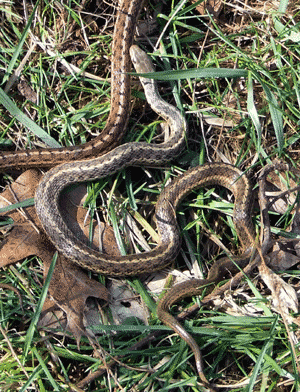
garter snakesIt’s the warmest day so far this month, 64 F by mid-afternoon. The snowpack lingers only in the shade of the woods and on north-facing slopes, and has sunk to just a few inches in depth. The invasive Asian ladybugs have awoken from hibernation in the walls and are crowding doors and windows. Outside, the air is abuzz with the call of the phoebe, who returned first thing this morning and spent much of the day hawking flies in the lawn and barnyard in the company of a bluebird. This is just the first of what I’m sure will be three or four male phoebes staking out territories around the houses, refurbishing old nests under the eaves of the shed, the springhouse, the barn, and the garage.

Steve hiked up around noon, and we watched the first turkey vultures soaring down Sapsucker Ridge, found the first garter snakes in the boggy lawn around the old wells, and spotted the first mourning cloak butterfly (see here), which obligingly landed right in front of my stone wall while we were standing outside talking.

This is only Steve’s second spring since returning to Central Pennsylvania, and a few things are different from what he remembers as a kid. For example, he was surprised to hear that we also count Compton’s tortoiseshell butterflies, now — I don’t think they used to be as common as they are now. And there’s no question that the garter snakes have grown much more numerous since we stopped mowing the lawn. It’s only in the past few years that we have regularly found large mating balls of snakes. I think Emily Dickinson is right that the garter snake “likes a boggy acre”; mowing lawns, as we used to do all the while we were growing up, really turns them into deserts.

UPDATE: Two woodcocks were doing their aerial displays above the field at dusk. That makes five new spring arrivals in one day!

–Dave

Swans

At 9:30 this morning, I watched the first tundra swans flying north over the hollow. I was walking on Black Gum Trail, which follows along Laurel Ridge about half-way between the road and the ridge crest, and had paused to watch a pileated woodpecker finding its breakfast in a dead limb of a nearby red oak. The pileated was hanging to the bottom of the limb, and I watched through the zoom lens of my camera as he tapped and fed, probably for carpenter ants. The swans were nearly silent and quite high up, and I’m sure I wouldn’t have noticed them if I hadn’t stopped. They were strung out in a line of about 25 birds, with only one bird following the leader on the other side to form a very lopsided “V.”

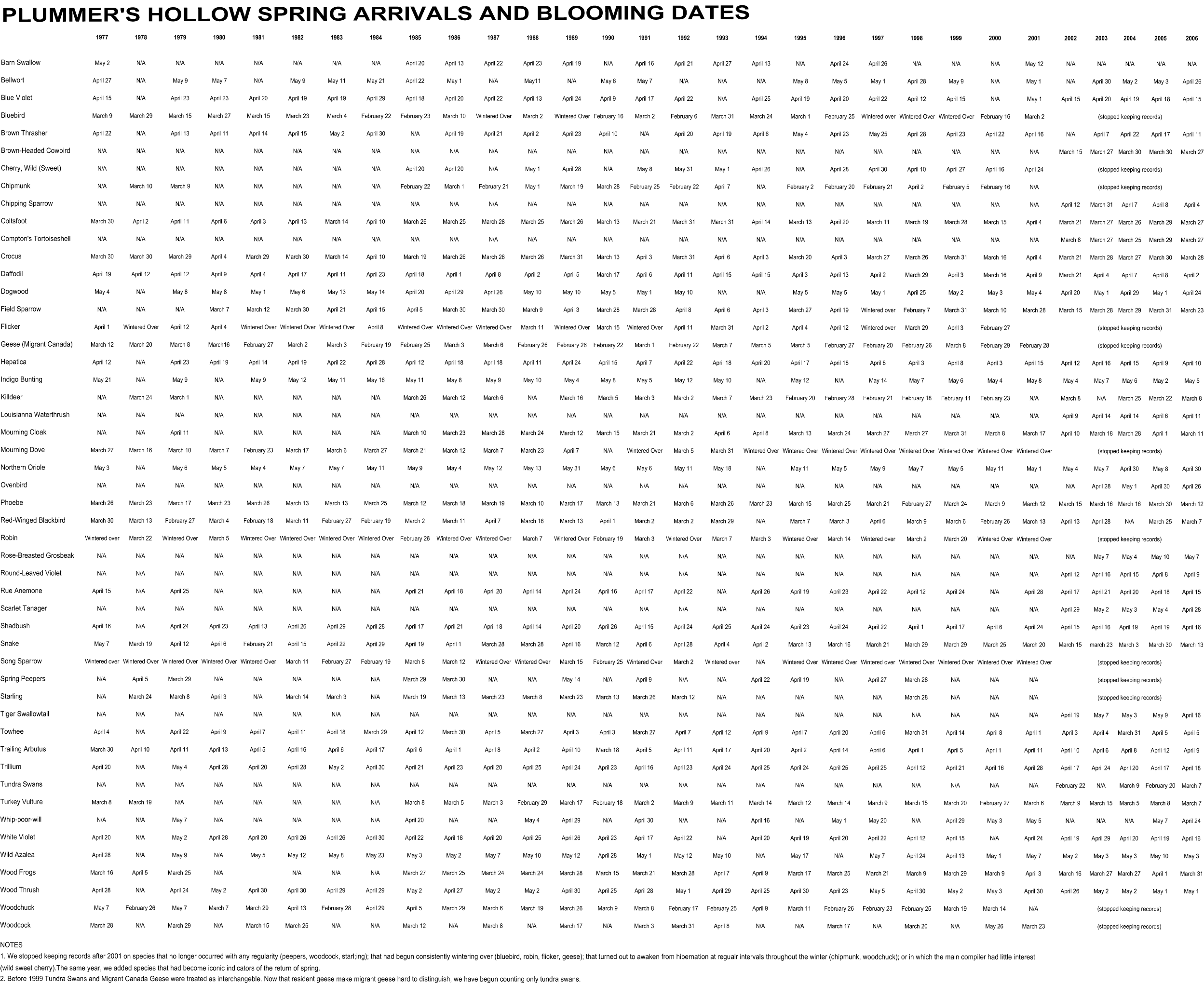
This too will be entered on the graph-paper version of our Spring Arrivals list, which has now been affixed to the refrigerator in my parents’ house. For many years, we recorded the date we first saw migrant Canada geese, instead, but stopped around 2002 because so many Canada geese had stopped migrating altogether — it became difficult to tell the migrants from flocks of local geese moving between local lakes and fields. That was a completely new phenomenon for our area; there were no year-round resident geese around here until sometime in the early- to mid-90s. To compensate, we began keeping records on swans, instead. Like Canada geese, tundra swans tend to fly over sometime between February 20 and March 15.

–Dave

First spring arrival of 2007

red-winged blackbird in snowstorm

Nineteen red-winged blackbirds flew in this morning around 7:30, in the middle of a snowstorm, and joined the other birds mobbing the feeders. This marks the first official 2007 entry in our Spring Arrivals and Blooming Dates list (click on list to magnify). Actually, red-winged blackbirds aren’t a particularly reliable species, since they can show up here on the mountain any time between late February and early April, sometimes well after they’ve returned to the area. They don’t migrate far. They almost always show up at the farm on foggy, rainy mornings in early spring; this is only the second time I can remember them making their first appearance in the middle of a snowstorm. Though one of the most common species in North America, they don’t breed on the mountain, so they’re always a bit of a novelty for us. Sometimes we see large flocks of them in the autumn, too, but in general they stick to the valleys.

The snow tapered off by 11:30 a.m. We got six inches of powder in all. Snowy, wintry Marches have become the norm for us in the last ten years or so: winters tend to start in mid- to late-December and continue through March. That’s a shift of at least two weeks from the 1970s, when I was a kid. This is one of the reasons we’ve kept such careful records of spring arrivals over the years — to help document the seasonal shifts associated with global climate change.

red-winged blackbird in snowstorm 2

–Dave