American Chestnuts in Plummer’s Hollow: A Census

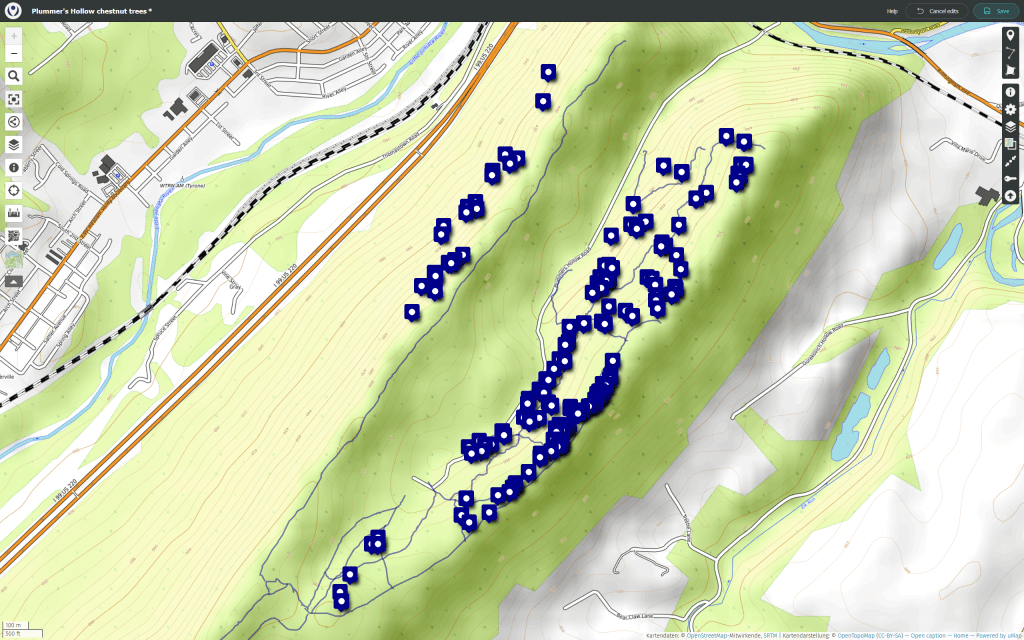
One hundred and fifty-two. That’s how many American chestnuts I was able to locate this autumn on our square mile of mountaintop land, after extensive wandering about the oak-heath forest on Laurel Ridge, their main stronghold, as well as the northwest-facing slope of Sapsucker Ridge, where a smaller scattering remains. I initially tagged each tree, sprout, or (in one or two possible cases) seedling with yellow surveyor’s ribbon, then came back after all the leaves were down to record a bit of data about each one: diameter at breast height, estimated height of tree, whether it’s on the way out, and if so, whether it has any basal sprouts poised to take over.
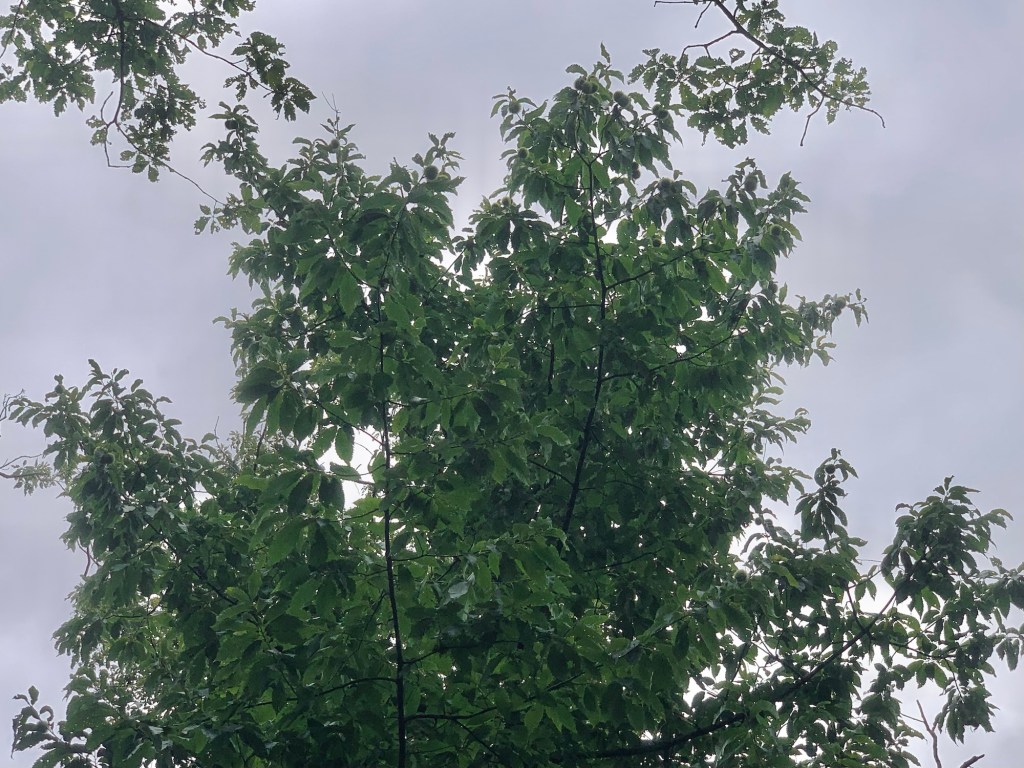
At present I’m using a free app on my phone, Avenza Maps, to record the data. A friend of Eric’s from the American Chestnut Foundation is interested in doing some genetic analysis, and we’ll see what comes from that. It’s possible that a few might actually be Castanea pumila — Allegheny chinquapin or dwarf chestnut, which is also affected by the blight. Many of them are quite tall, however, so I’m assuming that the vast majority are Castanea dentata, though they do also hybridize.
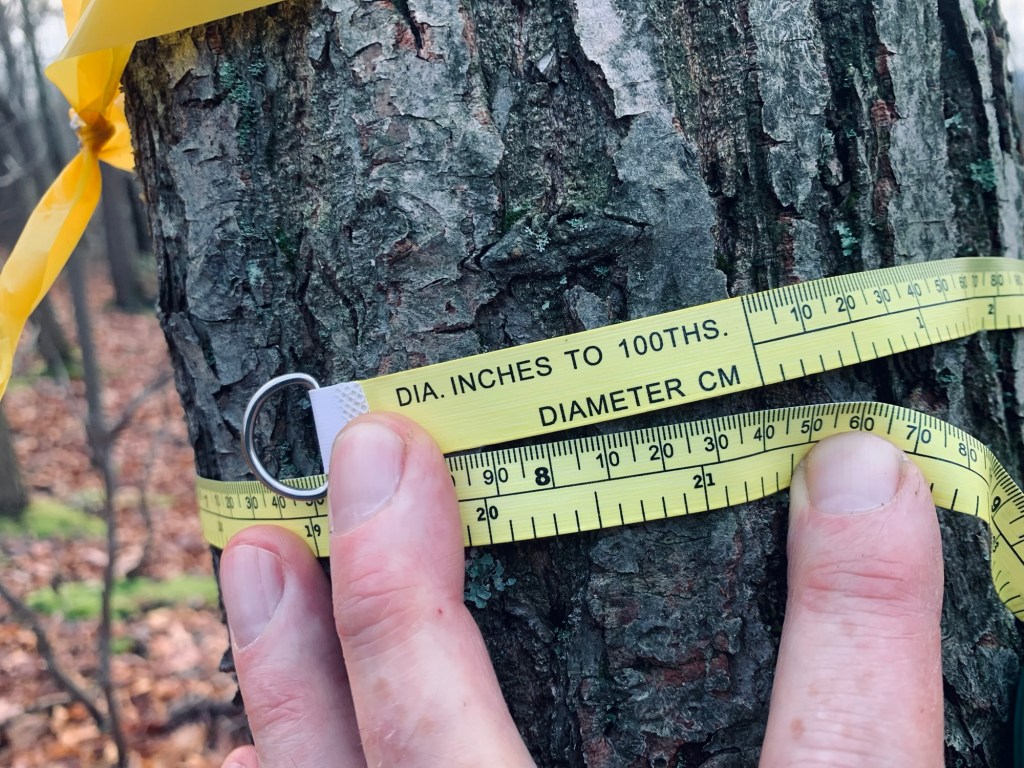
The biggest American chestnut on our end of the mountain is just over the line with a neighbor, and was the only one to bear nuts this year. It came in at 8.7 inches dbh (diameter at breast height, which is standardized at 4.5 feet) and is about 75 feet tall—canopy height where it’s growing. The largest on our own property is 8.4″ dbh and about 70 feet tall, just north of the ridge crest near the end of Laurel Ridge. In second place is one conveniently located adjacent to Laurel Ridge Trail: 7.9″ dbh, ~75 feet tall. Three more are over six inches in diameter, seven more are over five inches, 19 more are over four inches, 35 over 3 inches, and all the rest (80+) smaller than that. I took note of which ones were nearly dead with just one or two, badly deer-browsed sprouts: those will be candidates for deer fencing.
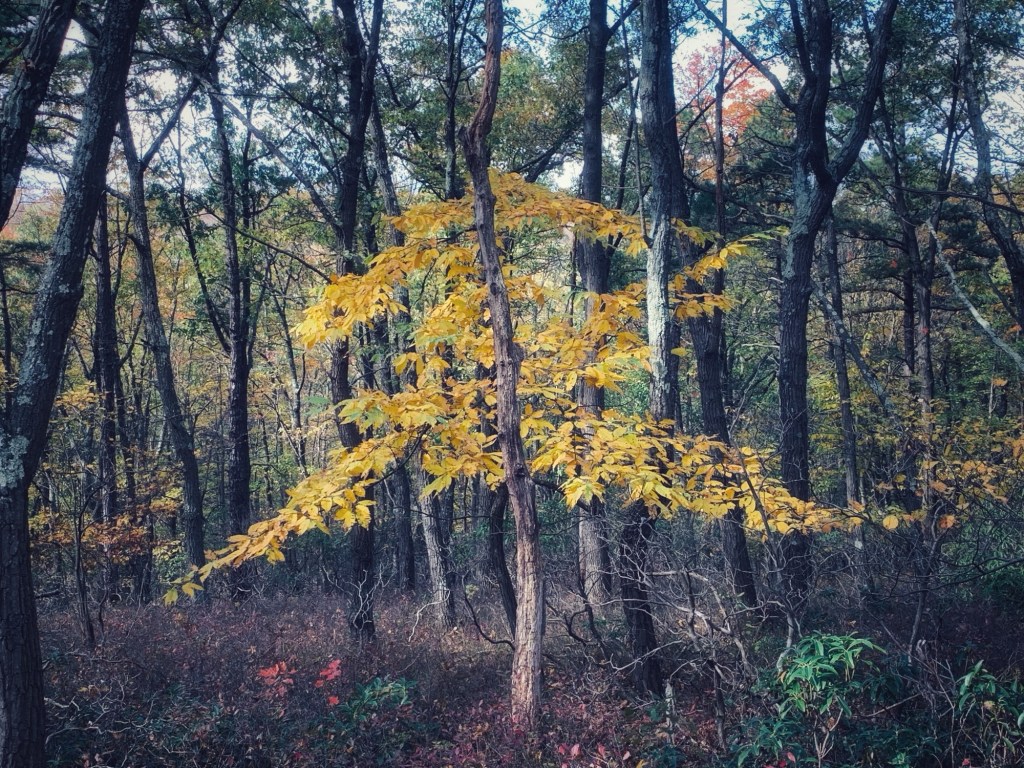
I’m sorry I didn’t start keeping records years ago, but better late than never. I just felt the need to better understand what trees (of various species) we have and how they’re doing in this time of fluctuating deer populations and new invasive species, pests and blights. It’s been heartbreaking to see the nemotode-caused beech leaf disease come into the hollow, bringing the very real possibility that all our lovely old American beeches will die, just as our white ashes have all been killed by the emerald ash borer, the butternut trees have all succumbed to butternut canker, and the wooly adelgid continues its slow decimation of the eastern hemlocks.
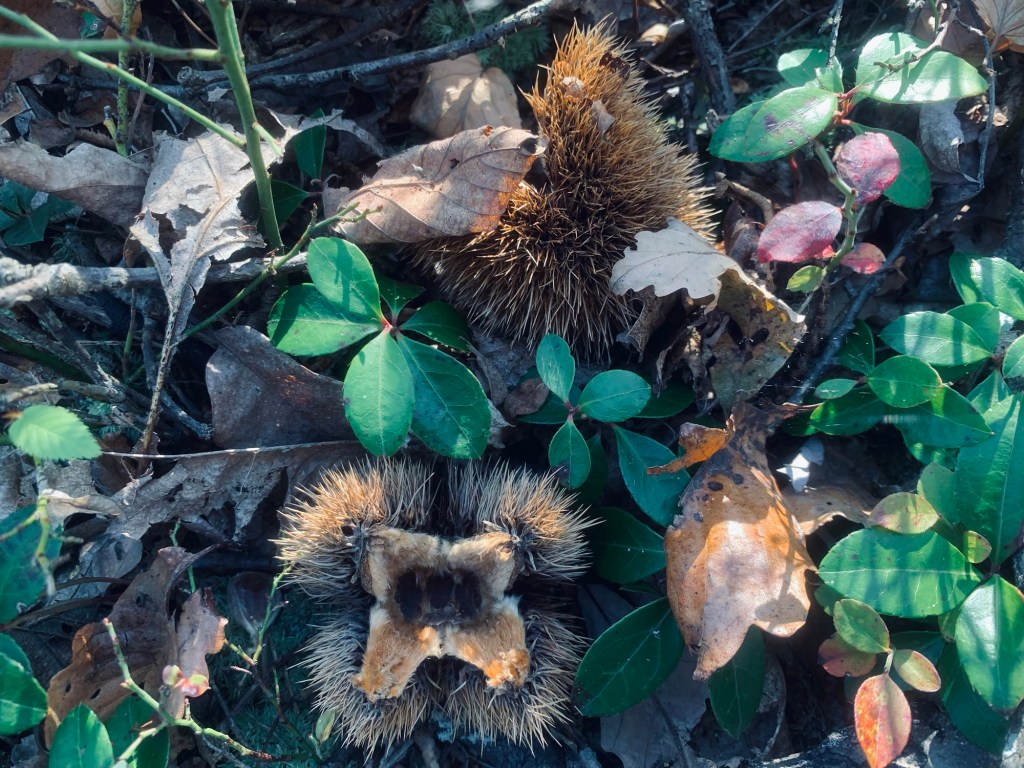
The spongy moth (formerly Gypsy moth), though controlled a bit by a virus and fungus now, can still do considerable damage to oaks, especially in combination with late freezes, which are a lot more common in recent years due to global weirding. This is however good news for some of the chestnuts, since canopy openings due to dead oaks may allow more Castanea trees to flower, ennabling cross-fertilization by their insect pollinators, and thereby maybe someday allowing the species to evolve resistance to the blight.

And that’s our primary management goal for chestnuts: to give them the maximum opportunity to evolve resistance—the work of centuries, most likely. So it seemed imperative to start keeping track of them, see whether their numbers are increasing, declining, or remaining about the same, and keep an eye out for possible new sprouts from the nuts these hoary old warriors are still able to produce, once in a while.

I’m not entirely sure where this project goes from here. If anyone has any thoughts or suggestions, leave a comment or otherwise get in touch. As a poet with dyscalculia, I’m not necessarily cut out for doing science, but I do love a good excuse to wander around in the woods, so I’m definitely planning more surveys of some of the rarer trees and shrubs, and possibly other landscape features such as old charcoal hearths. Mapping is not only fun, but can reveal patterns that are hard to see otherwise. The chestnut project showed what we’d always known based on casual observation, that the trees are concentrated on the ridgetops, but I was surprised at just how many grow on the lower slopes. And they clearly avoid the less acidic soil of the Juniata Formation in favor of its flanking Bald Eagle and Tuscarora formations. The relative few in the latter, on Sapsucker Ridge, either grow among the dense blueberry and huckleberry bushes flanking the open rock slopes—which provide plenty of sunlight for flowering—or on steep slopes, where deer don’t browse as much as on the ridgetop. Laurel Ridge, by contrast, has a much denser understory to protect the sprouts until they get past deer browse height (5-6 feet).

In any case, keeping the deer numbers as low as possible seems key to their long-term survival, so best of luck to all the hunters out there.
A Walk up Plummer’s Hollow

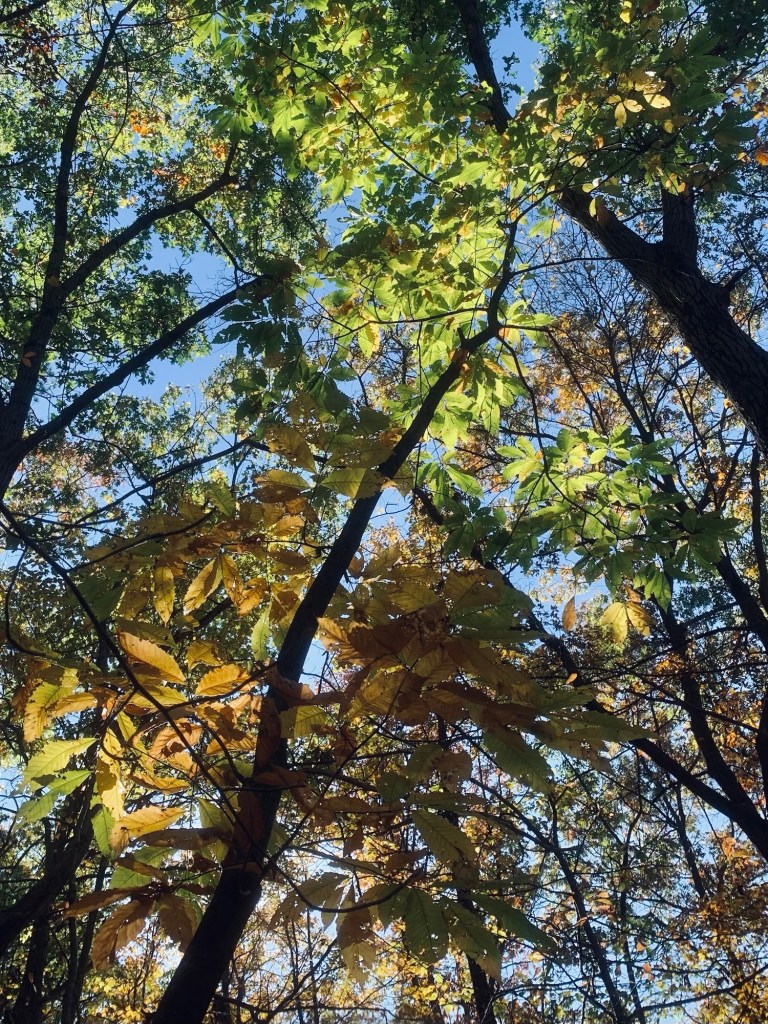
I took my camera for a walk up Plummer’s Hollow Road this morning, starting at the end of the country bridge over the Little Juniata and ending just below the houses, a distance of a mile and a half. View the slideshow or browse through the photoset.

How much carbon does our forest sequester?

locomotiveThe cover story in the current (Spring 2008) issue of OnEarth magazine, called The Giving Trees, includes some important information about the value of intact, mature forests. The author, Sharon Levy, describes something called the eddy flux method of measuring the flows of carbon dioxide and water vapor into and out of forests. Devices mounted on towers in forest stands measure winds and gas exchanges at incredible levels of detail and accuracy.

For anyone who might be a little fuzzy on the chemistry involved here, Levy offers a brief refresher course:

Plants take in CO2 and harness the energy of the sun to drive the chemical reaction that melds carbon with water, producing the substance of stem and leaf and releasing oxygen. When darkness or drought bring this process of photosynthesis to a halt, plants respire, just as humans do. That is, plants breathe in oxygen and exhale CO2. But over the long life span of trees in an undisturbed forest, huge reservoirs of carbon are stored for great stretches of time in the organic matter in soil as well as in living wood.

Most relevant to Plummer’s Hollow, Levy describes measurements of the intake and storage of carbon done at the Harvard Forest, in Petersham, Massachusetts, starting in 1989. The stand that scientists measured, predominantly an oak-maple forest, had been flattened by a hurricane in 1938. In the first year of the study, the 50-year-old forest was absorbing 0.8 tons of carbon per acre per year.

Previous calculations by ecologists had suggested that a forest of that age should be reaching its maximum ability to absorb carbon, but measurements at the Harvard Forest 15 years later showed that the rate of carbon sequestration had doubled. In other words, a 65-year-old forest absorbed 1.6 tons of carbon per acre per year. Other studies suggest that much older forests may continue to store carbon as they age — the older the trees, probably, the more and more carbon they store.

The idea the author is driving at is that there may be some very convincing arguments, in addition to familiar ones about wildlife habitat and water conservation, for preserving a lot of forest lands uncut. Older forests help in the fight against global warming.

The Harvard Forest is of course not Plummer’s Hollow, but we also own a mostly oak-maple forest. Excluding about 80 acres out of our 650 acres of land, where a savage cutting was performed 16 years ago before we could buy it, and excluding another 70 acres of recent blowdowns, open meadows, talus slopes, and places that have been selectively logged in the last 30 years, we still have at least 500 acres of forest ranging from 80 to 120 years old.

A 15- to 20-acre section of Laurel Ridge inside and above the large deer exclosure is closer to 200 years old, but much of the remaining 500 acres was last cut in the late 19th or very early 20th centuries. Thus, if the comparison to the Harvard Forest is roughly valid, I would speculate that the forest land in Plummer’s Hollow may be capturing 800 tons of carbon per year, and perhaps quite a bit more.

But other than showing that the property captures so many tons of carbon per year, how does this stack up against the amount of carbon we as a family contribute to the atmosphere through our annual activities? A variety of websites provide simple calculators so people can input data relating to their daily lives — home heating, transportation, consumption of goods — and get an estimate of how much carbon they contribute to the global atmospheric problem.

Ignoring the carbon footprint of the Guest House and its occupant, but including our one jet flight this year, the Carbon Footprint Calculator adds together a variety of estimates and comes up with a figure of 14.134 tons per year. The calculator provided by the Nature Conservancy returns a figure of 42 tons of carbon per year. A third calculator shows that we contribute 10.2 tons per year. Averaging those three calculations we come up with 22 tons per year.

The conclusion: our (mostly) healthy, moderately old, primarily hardwood forest offsets the carbon footprint of roughly 36.3 households with a reasonably low-consumption lifestyle like ours. Or to express it another way, we could live 25 times more extravagantly, wasting resources wildly, and still be net savers of carbon simply by preserving our private forest from being logged.

Not to sound greedy, but if state and federal governments are serious about combating global warming, perhaps forest landowners should get tax credits for not cutting their woods, comparable to the subsidies long enjoyed by farmers who enroll arable land in the Conservation Reserve Program.

— Bruce Bonta

The longest autumn

November farm

That was the view of Laurel Ridge on the day after Thanksgiving, showing that well over half the oaks not only retained their leaves, but retained their colors, as well. Most years, the trees would be bare by now.

According to an online draft of a paper accepted for Global Change Biology, “delayed autumnal senescence” may be due to an increase in atmospheric CO2. Quoting from the abstract:

Using freely rooted, field-grown Populus in two Free Air CO2 Enrichment Experiments (AspenFACE and PopFACE), we present evidence from two continents and over two years that increasing atmospheric CO2 acts directly to delay autumnal leaf coloration and leaf fall.

In an atmosphere enriched in CO2 (by ~ 45 % of the current atmospheric concentration to 550 ppm) the end of season decline in canopy Normalized Difference Vegetation Index (NDVI) – a commonly used global index for vegetation greenness – was significantly delayed, indicating a greener autumnal canopy, relative to that in ambient CO2. This was supported by a significant delay in the decline of autumnal canopy leaf area index (LAI) in elevated as compared to ambient CO2, and a significantly smaller decline in end of season leaf chlorophyll content. Leaf level photosynthetic activity and carbon uptake in elevated CO2 during the senescence period was also enhanced compared to ambient CO2. The findings reveal a direct effect of rising atmospheric CO2, independent of temperature in delaying autumnal senescence for Populus, an important deciduous forest tree with implications for forest productivity and adaptation to a future high CO2 world.

“Future atmospheric CO2 leads to delayed autumnal senescence,” by Gail Taylor, Matthew J. Tallis, Christian P. Giardina, Kevin E. Percy, Franco Miglietta, Pooja S. Gupta, Beniamino Gioli, Carlo Calfapietra, Birgit Gielen, Mark E. Kubiske, Giuseppe E. Scarascia-Mugnozza, Katre Kets, Stephen P. Long, and David F. Karnosky, Global Change Biology (OnlineAccepted Articles). See also Why Autumn Colors Are So Late, which summarizes the findings. (Hat tip: Meanwhile, back in the holler.)

— Dave

Clash of the seasons

aspens in snow

Our first snowstorm of the year yesterday brought two inches of wet stuff. That in itself might not be cause for comment, except for the fact that our oaks only reached their peak of color a few days ago, and many of the maples still hold their leaves, too. The preponderance of oaks among the canopy-height trees here is a bit of an anomaly; elsewhere in the area, the colors have mostly faded. So our autumn is a little later than the norm, perhaps.

red oak sapling in snowTwo inches is just enough to make everything pretty, but not enough to start breaking limbs — a real concern this time of year. Only three years ago, a mid-November ice-storm did a heavy pruning on many of the oaks. And too much wet snow when the ground is still unfrozen can fell trees, as happened here back in December 1992.

This morning, we had four finch species at the feeders: house finch, purple finch, goldfinch and pine siskin — good-sized flocks of the latter two. Mom has high hopes for a winter-finch irruption year. It would be our first in over a decade, if it happens.

To see all of yesterday’s photos, visit the date archive at my Flickr site.

The biggest tree

big tree 5

The latest post at Via Negativa, Living large, discusses the largest rock and the largest tree on the property, both located in the southwest corner of our border with I-99. I also uploaded a photoset to Flickr, Down in the corner.

I’m a little abashed that I don’t have a measurement for the tree. My dad had a brief enthusiasm for tree measuring some ten years ago, and recorded the breast-height circumference of many of the largest trees on the property. Unfortunately, he now can’t find the list. Whether or not it ever turns up, it would be interesting to go back and re-measure all our big trees sometime this winter. It occurs to me, though, that I ought to try and get ahold of a GPS unit so I can record the location of each tree. I could photograph them at the same time — another reason to do this in the winter, when the woods are so much lighter and tree architecture so much more visible.

–Dave