First snow

Three intertwined Vs of geese pass low over the house as I stand by the door. A chickadee had just dropped down into the bush beside me for a closer look, but the sudden clarinets spooked him, and he fled into the lilac, which is still wearing most of its leaves. “Canada geese” — we shall soon have to change the common name for these local birds that never leave the state. This is a new phenomenon since I was a kid, when we heard geese only during fall and spring migration, from high overheard. The proliferation of these so-called nuisance geese makes me both fearful and sad, like so many other things that are going haywire in the natural world. Fearful because I wonder what further changes it portends, and sad because — like hayscented fern, like white-tailed deer, like red maple — the geese are still as beautiful as they were before. Something must go wrong with our seeing, I think, if treasure can so easily turn to trash.

The goose-music, as Aldo Leopold fondly called it, echoes off the ridges for another half a minute; the course of the flock is almost parallel to the hollow. Then the chickadee returns to the bush, bringing a companion, and both birds scold me from a couple feet away. Mom only got around to putting out the feeders for the first time yesterday afternoon, but already the number of birds around the houses has increased ten-fold.

It’s around 10:00 in the morning. The sun is burning through a light cloud cover brightly enough to make faint, fuzzy shadows, many of them still inhabited by last night’s first dusting of snow.

–Dave

The coldest April

Spring has stood still for almost two weeks. Today I heard and saw all the same birds that I heard and saw last week and the week before along Greenbrier Trail, down the road and around the house and field.

The stream runneth over, and that precious commodity–water–still graces our property in abundance. The coldest April on record, so they say, and spring remains as elusive as ever. Sitting on Waterthrush Bench, I heard a scolding Louisiana waterthrush, but he refused to sing. Who can blame him? The purple trillium had broken ground, and many hepatica buds were just waiting for a little sunlight to open.

All the sparrow species are still here– fox, tree, chipping, field, song, swamp, white-throated, and junco. The swamp sparrow is incredibly feisty and fights off other species.

© Marcia Bonta

Our eyes are on the sparrows

swamp sparrowThe recent cold snap that began two days ago followed several days of warmth that had brought out daffodils, trailing arbutus (as mentioned in the previous post), spicebush, and the first hepatica. None of these flowers should be damaged by a freeze. And Steve spotted another major new spring arrival in the hollow, the Louisiana waterthrush: right on schedule. The cold may have had the effect of bottling up some migrants, though. Swamp sparrows often show up here on migration, touching down briefly in the boggy corner of the field, but this is the first we’ve ever had one at the birdfeeding area below the back porch of the main house (photo). It has been spending much of its time there for the past three days. At least one tree sparrow is still coming, too, along with a fox sparrow — both species that should have been on their way north by now. The latter has even been singing from time to time — a rare treat. At the same time, the field sparrows and chipping sparrows have come back from their winter homes in the south. Rounding out the roster are song sparrows, slate-colored juncos* and white-throated sparrows, for a total of eight sparrow species at one time.
__________

*Currently classed as a form or subspecies of the dark-eyed junco. I refuse to change my usage of common names every time the American Ornithological Union changes a classification; that’s what Latin names are for. As far as I am concerned, the solitary vireo is still the solitary vireo, the Baltimore oriole never stopped being the Baltimore oriole, and unless you’re a life-lister or a taxonomist you have no reason to care about any of this.

–Dave

First spring arrival of 2007

red-winged blackbird in snowstorm

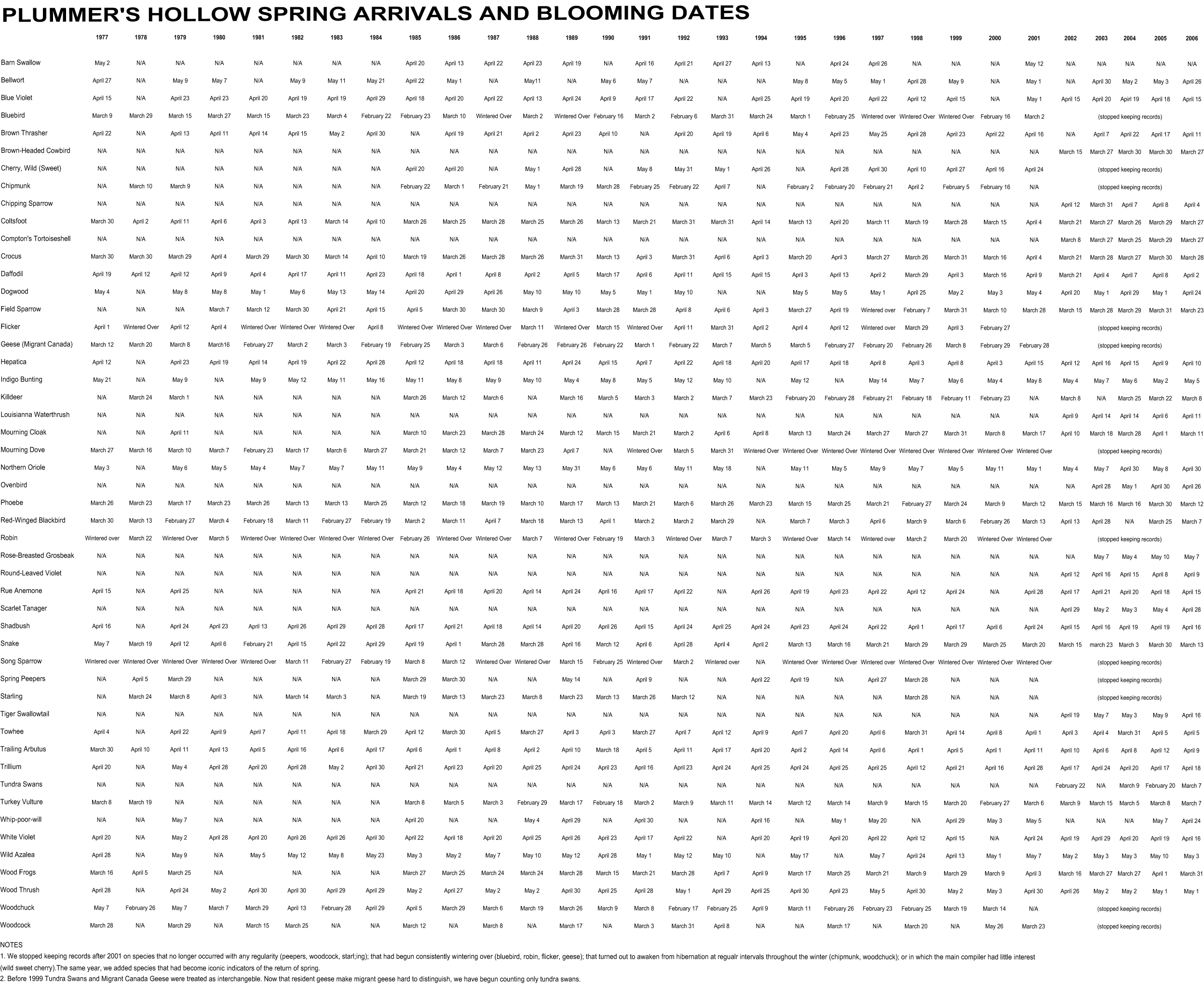
Nineteen red-winged blackbirds flew in this morning around 7:30, in the middle of a snowstorm, and joined the other birds mobbing the feeders. This marks the first official 2007 entry in our Spring Arrivals and Blooming Dates list (click on list to magnify). Actually, red-winged blackbirds aren’t a particularly reliable species, since they can show up here on the mountain any time between late February and early April, sometimes well after they’ve returned to the area. They don’t migrate far. They almost always show up at the farm on foggy, rainy mornings in early spring; this is only the second time I can remember them making their first appearance in the middle of a snowstorm. Though one of the most common species in North America, they don’t breed on the mountain, so they’re always a bit of a novelty for us. Sometimes we see large flocks of them in the autumn, too, but in general they stick to the valleys.

The snow tapered off by 11:30 a.m. We got six inches of powder in all. Snowy, wintry Marches have become the norm for us in the last ten years or so: winters tend to start in mid- to late-December and continue through March. That’s a shift of at least two weeks from the 1970s, when I was a kid. This is one of the reasons we’ve kept such careful records of spring arrivals over the years — to help document the seasonal shifts associated with global climate change.

red-winged blackbird in snowstorm 2

–Dave

Who’s Afraid of the Big Bad Cold?

It was two degrees below zero Fahrenheit (-18 C) on Bruce’s thermometer this morning. The probe on the front porch registered three minus signs until it reached minus one degree Fahrenheit later in the morning. Birds flocked to the feeder area as I made breakfast. Then thump. Something had hit the bow window hard. A Cooper’s hawk sat below the window and took off as soon as I looked out. All the little birds had fled.

Many schools were cancelled including Tyrone. I couldn’t believe it. In Maine, at 40 below, I removed the heater from the car engine, bundled baby Mark in layers of clothes, and took Steve to first grade and Dave to nursery school in our Volkswagen bus that never warmed up above zero during our half hour ride. No one ever talked of calling school because of the cold.

And here, one year when Bruce was off to a conference in January and the boys had to get to school on their own, I walked them the two miles down to town at zero degrees, we stopped at a restaurant and they had hot chocolate to warm up, and then they walked on to school while I walked home. I remember the hoarfrost clinging to the trees beside the river and forming on my hair. In those days, Tyrone didn’t cancel school because of the cold. No wonder kids stay indoors like their parents, mesmerized by technology and getting fatter day by day. The outdoors has become something to fear.

Yesterday, it was almost as cold, but the Pittsburgh-based environmental/nature show Allegheny Front, carried on WPSU-FM, devoted most of its half hour program to winter sports–cross-country skiing, snowshoeing, and ice skating–and mentioned that many people get depressed in winter because they stay indoors.

“Get outside. Enjoy the beautiful weather, the tranquility of the forest, etc.” was the essence of their message. But during station breaks, the local announcer kept warning that there was a cold weather alert until 11:00 a.m. Tuesday because of the cold and wind chill! The Allegheny Front folks intoned, “It’s not the weather; it’s wearing the proper clothes,” or something like that. Then, another station break and more warnings. What a disconnect!

I waited until 10:00 a.m. to go out this morning. By then it was two above and windy, but it was lovely walking across First Field to Margaret’s Woods where a song sparrow flew up, and on down Ten Springs Trail where a titmouse foraged on a patch of open ground on the bank.

I sat on the snow, my hot seat beneath me, along Pit Mound Trail to write notes, where I was protected by the wind and the sun shone brightly. Then on down the road, silent except for chickadees feeding on hemlock cones. Under the hemlocks, the stream was frozen. Even the chute was a thick sheet of ice. But at the big pulloff, the stream ran freely. A regular parade of deer tracks headed down for water. The hollow itself gave me a quiet interlude despite the wind that rustled the trees overhead and grew more insistent the farther up the road I walked.

Throughout the day, at the feeder area, I counted 14 bird species altogether including 35 juncos, two goldfinches, 22 mourning doves, two song sparrows, three tree sparrows and a singing house finch. But I heard no Carolina wren song. Could this cold have killed them?

© 2007 Marcia Bonta