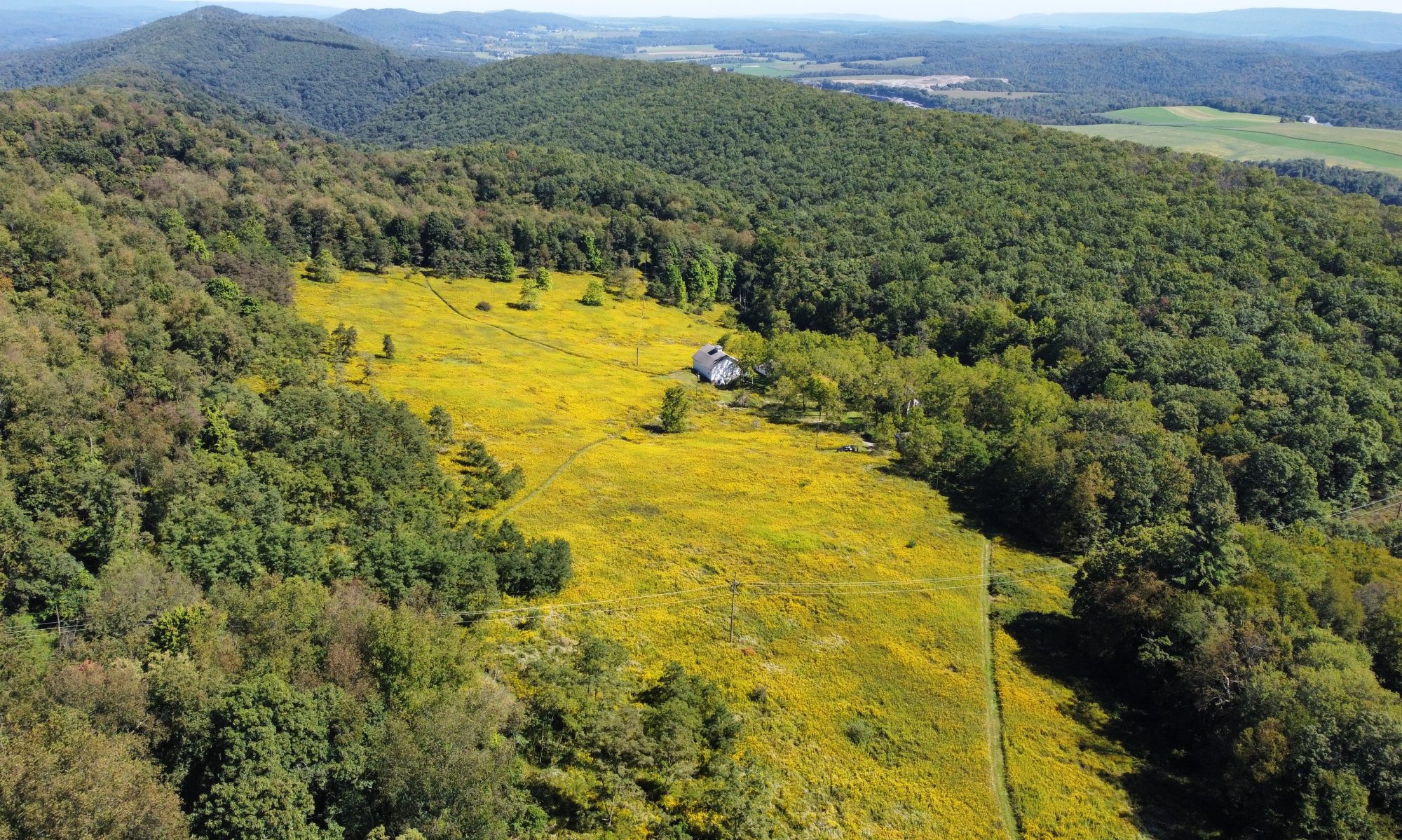
Our over-all goals for the property are to preserve biological integrity to the greatest degree possible, to keep common species and ecosystems common, and to reintroduce or otherwise recover rare and extirpated species and ecosystems. We maintain about 40 acres of old field habitat for grassland birds and insects. Otherwise, we are growing a future old-growth forest through deer management, invasive species control, and new plantings.
The Western Pennsylvania Conservancy holds a conservation easement on the property intended to protect the hollow for future generations.
Other Conservation Goals
- preserve and recover as many oaks as possible from each native species, all of which are keystone organisms along with their fungal partners
- greatly increase the proportion of native conifers, especially white pine, pitch pine, eastern hemlock and red spruce
- work to restore a native shrub understorey to all forest types
- maintain old meadow habitat for birds but focus on creating a varied, savanna-like landscape with more small groupings of native trees and shrubs, including a wildlife corridor through the ‘amphitheater’ section
- recover as many wetland areas as possible
- preserve subsistence options for future residents by planting or recovering highly edible and medicinal native species such as white oak, shagbark hickory, butternut, American plum, pawpaw, persimmon, sugar maple, sarsaparilla, sassafras, wild anise, greenbriar, blackberries, elderberries, etc. If there’s an economic incentive for maintaining the forest, people are more likely to value it even in the event of total societal collapse
Basic Strategies
- deer culling through a managed hunting program
- invasive species removal or suppression (keeping in mind that eradication is impossible in most cases)
- native plantings
- temporary deer fencing or other protective measures where appropriate
Growing Future Old-Growth
Why manage for old growth? A survey of available literature suggests that, while every forest is different, generally speaking, large tracts of old-growth forest in Pennsylvania should be unexcelled providers of:
- Breeding habitat for a wide range of birds whose populations reach their greatest density in old growth, including winter wren, Acadian flycatcher, black-throated green warbler, Blackburnian warbler, magnolia warbler, Swainson’s thrush, brown creeper, and blue-headed vireo
- Habitat for embattled native fish and other organisms endemic to forested, cold-water environments, including the prized brook trout as well as a number of state threatened and endangered species [Note that Plummer’s Hollow Run does not currently have any trout, probably due to the pipe under the railroad.]
- Habitat for rare and endangered species such as Indiana bat, little brown myotis, and cerulean warbler, a candidate for listing as threatened on the federal Endangered Species List
- Excellent, perhaps optimal habitat for species in danger of extirpation or facing steep declines in Pennsylvania such as northern flying squirrel, green salamander, sugar maple longhorn beetle, yellow-bellied flycatcher, and eastern woodrat
- Optimal habitat for many sensitive, slow-dispersing wildflowers that may require over 150 years to fully recover from the effects of clearcutting
- Optimal habitat for top carnivores such as northern goshawk, barred owl and (arguably) fisher, plus some presently absent or of uncertain occurrence in Pennsylvania: pine marten, gray or red wolf, eastern cougar, and lynx
- Optimal conditions for salamanders (top carnivores and likely keystone species in the forest litter) and essential refuges for these logging-sensitive organisms
- Optimal conditions for some forest-dwelling bats such as eastern red, big brown, silver-haired and hoary bats
- A full complement of native ferns, mosses and liverworts
- A full complement of native forest lichens
- A full complement of fungi, including mycorrhizae and other soil microorganisms essential for forest health, nutrient uptake by trees, and recovery after a disturbance
- Structural diversity, including pit-mound microtopography, nurse logs for tree seedlings, habitat and runways for small mammals and herps, and standing snags
- Superior masting by many trees, such as white oak, red oak and American beech
- A full complement of native forest insects and other arthropods
- Functional and genetic resistance to insect pests
- Functional and genetic resistance to disease
- Formation of unique biogroups of trees–interspecific communities with distinct physical and physiological traits–through root grafting and and the formation of fungal bridges
- Seed banks with a full range of genetic variables for commercially desirable tree species
- Timber of unparalleled quality for specialized uses [though our conservation easement forbids any commercial timbering]
- Baselines for scientific research, including on strategies for successful recruitment and stand replacement
- A full range of natural soundscapes
- A source of aesthetic and spiritual values unattainable elsewhere
- The creation of optimal forest soils through accumulation of humus in the O and A horizons, periodic mixing of horizons by uprooting, and the formation of macropores
- Groundwater purification and storage (old trees use less water for growth)
- Flood control through maximal absorptive capabilities and stream bank stabilization
- A dependable source of coarse, woody debris essential to the ecological functioning of streams in forested ecosystems
- Clean rivers, bays and oceans though maximal prevention of siltation
- Drought prevention through transpiration to the atmosphere
- Sequestration of carbon dioxide
- Amelioration of local, regional, and global warming
 Plummer's Hollow, Pennsylvania