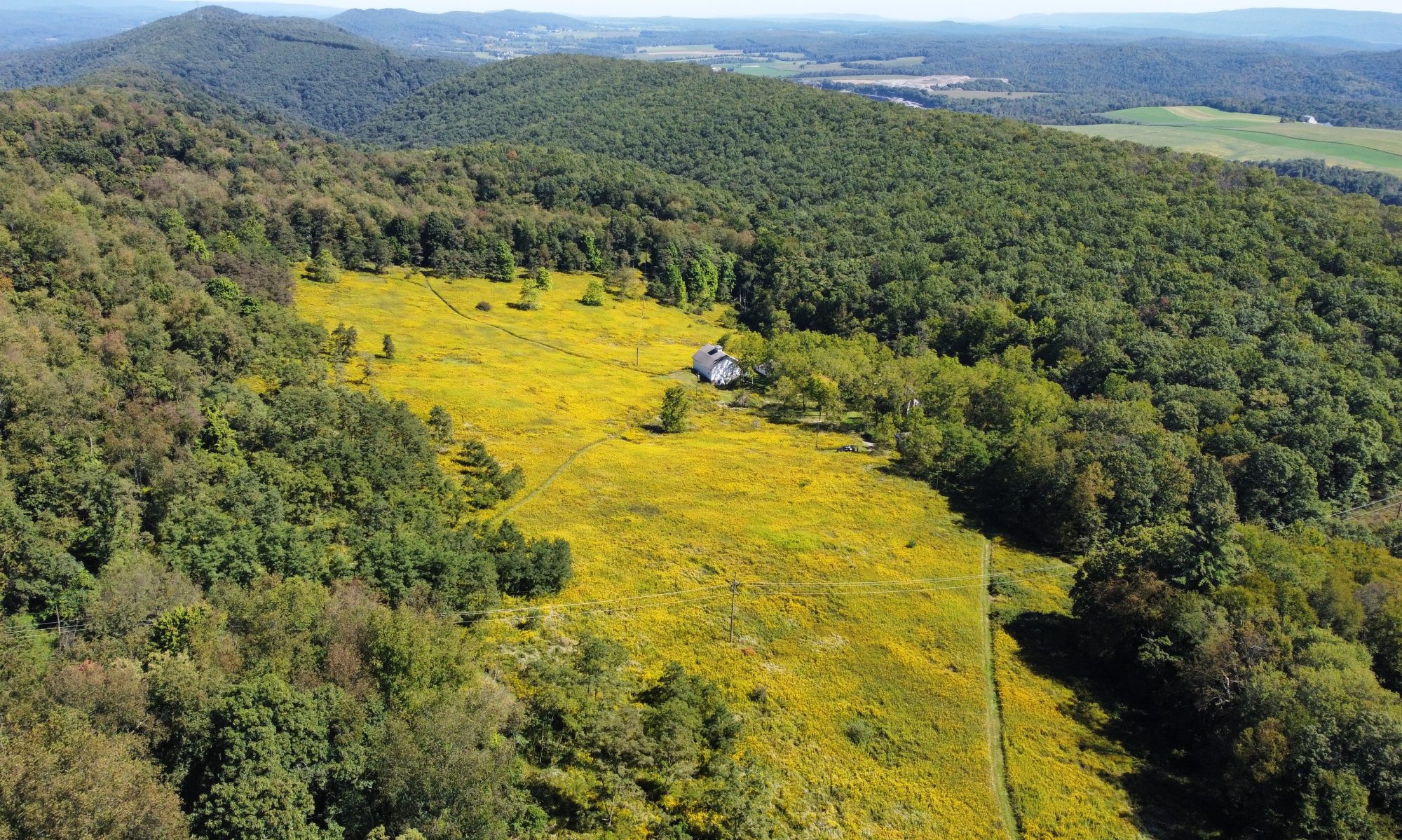
Description of Property
The property consists of 648 acres of mountain land in Snyder and Tyrone Townships, Blair County, near Tyrone, in Management Unit 4D. Approximately 30 acres are old field habitat, kept open primarily for invertebrates (e.g. monarch and Baltimore checkerspot butterflies) and birds (woodcock, field sparrow, Lincoln’s sparrow, indigo bunting, etc.). Over 120 acres are in early forest successional stage following a 1991 clearcut and the devastating ice storm of January 2005. Most of that area has been impacted by a series of human and natural disturbances dating back into the 19th century, including plowing and pasturing of livestock on steep slopes with thin, acid soils. Since 1991, ailanthus, barberry, privet, stiltgrass, mile-a-minute vine, and tatarian honeysuckle have become dominant on many southeast-facing slopes, with only small patches of native vegetation persisting. Before 1991, white oak, red oak, hickory, tulip poplar and black cherry were the dominant overstory species in this portion of the property. Most of the rest of the forest consists of maturing second-growth forest at or around the 120-year-old mark considered by some ecologists to satisfy at least a minimal definition of old growth. This is primarily in the dry oak – heath forest type, grading into a rich hemlock – mesic hardwoods forest along the stream that bisects the property (Plummer’s Hollow Run). A number of indicators of high-quality, interior forest habitat are present, including basswood, pink lady’s-slipper orchid, Acadian flycatcher, cerulean warbler, and pileated woodpecker. Abundant dead snags and fallen woody debris are present throughout the property. Changes in the soil by acid deposition and non-native earthworms render all portions of the property more susceptible to the establishment of invasive plants.
Deer Management Goals
- Recover a diverse forest ecosystem dominated by native species
- Maintain old-field habitat
- Preserve opportunities for wildlife watching and nature education for ourselves, our hunter friends, and other members of the local community, including Penn State students in Environmental Studies, to whom we always stress the central importance of hunting as a management tool
- Help preserve hunting traditions and promote responsible, sustainable hunting
Site Access and Hunting History
Though we have owned some portion of the present property since 1971, we only gained control of the entire Plummer’s Hollow watershed following the clearcut in 1991. Prior to that time, most of it was un-posted, and the mile-and-half-long, private road that follows Plummer’s Hollow Run to the old farm near the top of the watershed was completely open. Poaching was common, and perhaps as a result, deer numbers were low through the 1970s and the early 80s. In the mid-80s, we watched once-abundant plants such as blackberries, raspberries and elderberries disappear as deer numbers skyrocketed. By the early 90s, herds of 70-80 deer were a common sight at dusk.
With the gating of the road and the institution of a permission-only hunting program in 1992, we were able to reverse this trend. We befriended a small number of skilled hunters and their families who hunt for free (including turkey and small game seasons) in exchange for a commitment to take out as many antlerless deer as they can. With their help, we have constructed two parking areas on the property and a number of trails, and the hunters are encouraged to use portable tree stands and cooperate on drives. We encourage them to hike the property in all seasons so they can better understand where the deer are and how they are impacting the forest.
Our deer hunting program has been a success, both in our terms and in theirs. An average of 18 hunters every year get a quality hunting experience, and they have generally been able to harvest more than the average number for the management unit (formerly for the county)… until now. Unfortunately a local outbreak of CWD appears to be decimating the deer herd and hunting has gotten a lot harder over the past few years. We’re also seeing our hunter friends age out of the sport without necessarily recruiting kids or grandkids to replace them.
Justification for Additional Antlerless Deer Permits Through the DMAP Program
Decades of overbrowsing by deer have severely degraded understory diversity and canopy recruitment throughout the wooded portion of the property. We have constructed two, permanent deer exclosures to help us measure the success of our deer management program. The larger of the two, constructed in 2001, gave us a strong indication of the extent to which deer browsing has impacted such species as wild grape, black gum and witch hazel — all valuable sources of wildlife food and cover. Even mountain laurel sprouted vigorously inside the exclosure.
Over the past decade and a half, however, we have seen a jump in the recovery of deer-sensitive species outside the exclosures, too. Spring ephemeral wildflower species have spread beyond their refugia on the steepest slopes in the hollow, with Solomon’s seal and perfoliate bellwort showing up in places where we’ve never found them before. Canada mayflower plants are lasting long enough to blossom. In the spring of 2012, we noted many mats of spring ephemeral wildflowers spreading in the flat areas. Red-flowering elder seedlings are appearing everywhere in mesic sites, along with rhododendron sprouts, maple-leafed viburnum and eastern hemlock seedlings. In 2015, we began noticing a large number of white pine sprouts on ridgetop portions of the property and in the spring of 2016 the growing profusion of Canada mayflowers in some areas. We attribute all these changes to the long-term hunting success of the hunters on our property, but recognize as well the impact of the higher antlerless allocations and longer seasons introduced by the Game Commission.
The problem is that our property is long and narrow, and is surrounded by private forested lands, all of them logged within the past 25 years and some of them restricted to the use of very few hunters. In much of the acreage bordering ours, no doe hunting is permitted. Some neighbors feed deer throughout the winter, drawing them down off the mountain (and increasing the risk of CWD). The rich farm fields of Sinking Valley are less than half a mile away.
This is a critical time. The hemlocks that dominate in some portions of the deep hollow are succumbing to the woolly adelgid, and it’s an open question whether the new openings will be filled by native tulip poplars and basswood, or taken over by ailanthus and Norway maple. Most canopy-height white ash trees are dead as a result of emerald ash borer infestation. Beech bark disease has begun to afflict a few of the oldest beech trees. The mountain laurel understory, critical for the nesting success of several species of forest birds, has declined due to a blight—to the dismay of our deer hunting friends as well, since it had provided such attractive cover for deer in the past. The many acres opened up by the ice storm of 2005 are still struggling to regenerate, in addition to new openings from storms in 2021, and we’re hoping to see more black cherry, sassafras, Hercules’ club and white oak.
We’re several years into an ambitious program of invasive shrub removal on the property, so it’s critical to maintain relatively low deer numbers while native shrubs get established in the worst-hit areas. This includes on the un-logged slopes where the mountain laurel is dying out, but where rhododendron sprouts struggle to get above browsing height. We are not dissatisfied with the current size of the deer herd, but we feel we can’t ever let up on the hunting pressure, barring radical changes in the hunting patterns of our neighbors.
Finally, we are concerned, as so many people are, about the continuation of hunting traditions in the 21st century, with so much competition from electronic distractions. Several hunters on the property seem to be successfully recruiting their (grand-) daughters and sons, and we know that they appreciate the extra chance at hunting success that DMAP tags provide.
But with hunting becoming more difficult as deer numbers dwindle, we need to do all we can to retain the hunters we have now, and what they’re telling us they need are plenty of DMAP tags for maximum flexibility. That more than anything explains why we’re asking for as many as we are: whatever it takes to keep up the pressure on the deer.
 Plummer's Hollow, Pennsylvania