
Walking into the house after dark, I snap on the light and notice a thumb-sized lump under my shirt, right above my navel. It’s moving, though I don’t feel anything. I lift the shirt and there, clinging to the other side of the green cotton, is a periodical cicada. I pull it off, carry it outside and give it a toss. A dry rattle as it flutters off into the night. Maybe those strange red eyes can see in the dark.
For seventeen years — an eternity for most insects — they’ve been living completely in the dark, the cicadas of Brood XIV. Silent, wingless, and pale as ghosts they have burrowed from root to root, sucking on the milk of trees. Then in late April they began to experience subtle changes in their bodies, growing new muscles, and feeling a sudden strong urge to burrow upwards. Rather than push the dirt behind them like a mole or pass it through their bodies like a worm, their powerful forelegs pushed and compacted the newly thawed earth into half-inch cylinders as they climbed.
They dug to within an inch or less of the surface, making visible mounds in the mud and leaf duff in wetter areas. Skunks and other predators dug some of them up, and for weeks we were puzzled by what turned out to be dried sections of their bore-holes scattered all over our trails. My mother took to collecting these strange artifacts in a shoebox in her study; we couldn’t remember ever seeing anything like it. If we weren’t such rationalists, we might’ve thought the Little People were taking a crash course in pottery.

The nymphs sat in their burrows and waited for the onset of warm nights, a wait that might have lasted only a couple weeks some years, but this year — THE year, as far as they were concerned — it was closer to six. Four days ago I saw my first red-eyed cicada on a dead raspberry cane and realized that the emergence had begun.
Yesterday — the morning after I carried a cicada in under my shirt — I waded slowly through the thick air of our first heat wave since last April, up to the crest of the ridge above my house and southwest along the trail. It sounded as if our closest neighbor in the valley were operating some kind of machinery, I thought, but couldn’t quite figure out what — an eerie metallic buzz. Then I realized: it’s them. They’re here! I picked my way down to where the slope turned steep, but still the sound was below me, coming from an open area that had been logged about a decade before. The sunny, southeast exposure must have led the cicadas there to emerge earlier than those elsewhere on the mountain.
It occurred to me that there might be some activity on the powerline right-of way. I always associate powerlines with cicadas, in part because their calls have such an electronic quality. But in fact because the powerline opening is several degrees warmer than the surrounding woods, the night before last had indeed been a scene of mass ecdysis there, the nymphs emerging from their burrows, crawling a foot or two up into the vegetation, and climbing right out of the center of their wingless thoraces. By dawn, all would’ve darkened from white to bluish gray with red-veined wings. When I arrived on the scene at mid-morning, nearly every lowbush blueberry and scrub oak shrub was dotted with adult cicadas, and some of them were beginning to take short, clumsy flights, like remote-controlled toy airplanes piloted by inexperienced hands.
I found one two-foot-tall scrub oak as heavily ornamented as a Christmas tree. When I squatted with my camera for a closer look, I noticed the translucent brown larval shells, or exuviae, clinging to the undersides of the leaves. I couldn’t help thinking that whatever whacked-out evangelical preacher first dreamed up that Rapture business must’ve witnessed a 17-year cicada emergence.

By this afternoon, I was beginning to hear them from the treetops right outside my door. I walked back up to the powerline to see if I could find any singing at close enough range to film, but they’d all moved on — up into the treetops, I suppose. I also noticed, however, an alarming number of half-inch-diameter holes stippling the ground almost everywhere in the woods mdash; there must be few species of native trees they don’t patronize. The ecological consequences of their aeration of the forest soil must be immense.
Things are going to get pretty loud here in the coming days, I think. As the aforelinked webpage puts it, “Soon after emerging, males begin their constant ‘singing’ while females remain silent. The sound made by adult males is sometimes haunting and eerie.”
After around ten days of cacophony and orgiastic mayhem, the females will begin laying their eggs and the next cycle of this longest-lived of North American insects will begin. Rather than sow their seeds in the earth, as one might expect, they instead plant them in the treetops, long ovipositors slicing like harrow blades into the twigs of trees and shrubs from nearly 80 different species. Each female lays some two dozen eggs per slit, and repeats the process until all her 400-600 eggs are gone. Where two weeks before, the adult cicadas emerged from slits in the backs of their former selves, now they insert their future offspring into slits cut into what will become their nurse-trees.
The true opposite of ecdysis, I suppose, is death, and a month from now the ground should be littered with cicada carcasses. By the time the white, ant-sized cicadas hatch in late August and drop to the ground, most traces of their parents should be gone.
Needless to say, birds, squirrels, and virtually every other macrofaunal inhabitant of the forest will have a heyday, feasting on this almost literal fat of the land. Early European settlers in eastern North America marvelled at the teeming wildlife, almost all of which have by now been sadly diminished, if not persecuted to extinction, with the exception of a few superabundant pest species such as tent caterpillars and white-tailed deer. The mass emergence of the 17-year cicadas is one of the last great spectacles of its kind.
–Dave
Cross-posted to Via Negativa. For more on periodical cicadas — much, much more — see the Cicada Mania blog. For an MP3 of the singing, go here. And since I was just talking about nature documentaries yesterday, I’d be remiss if I didn’t mention the fine film “Return of the 17 Year Cicadas” on YouTube.
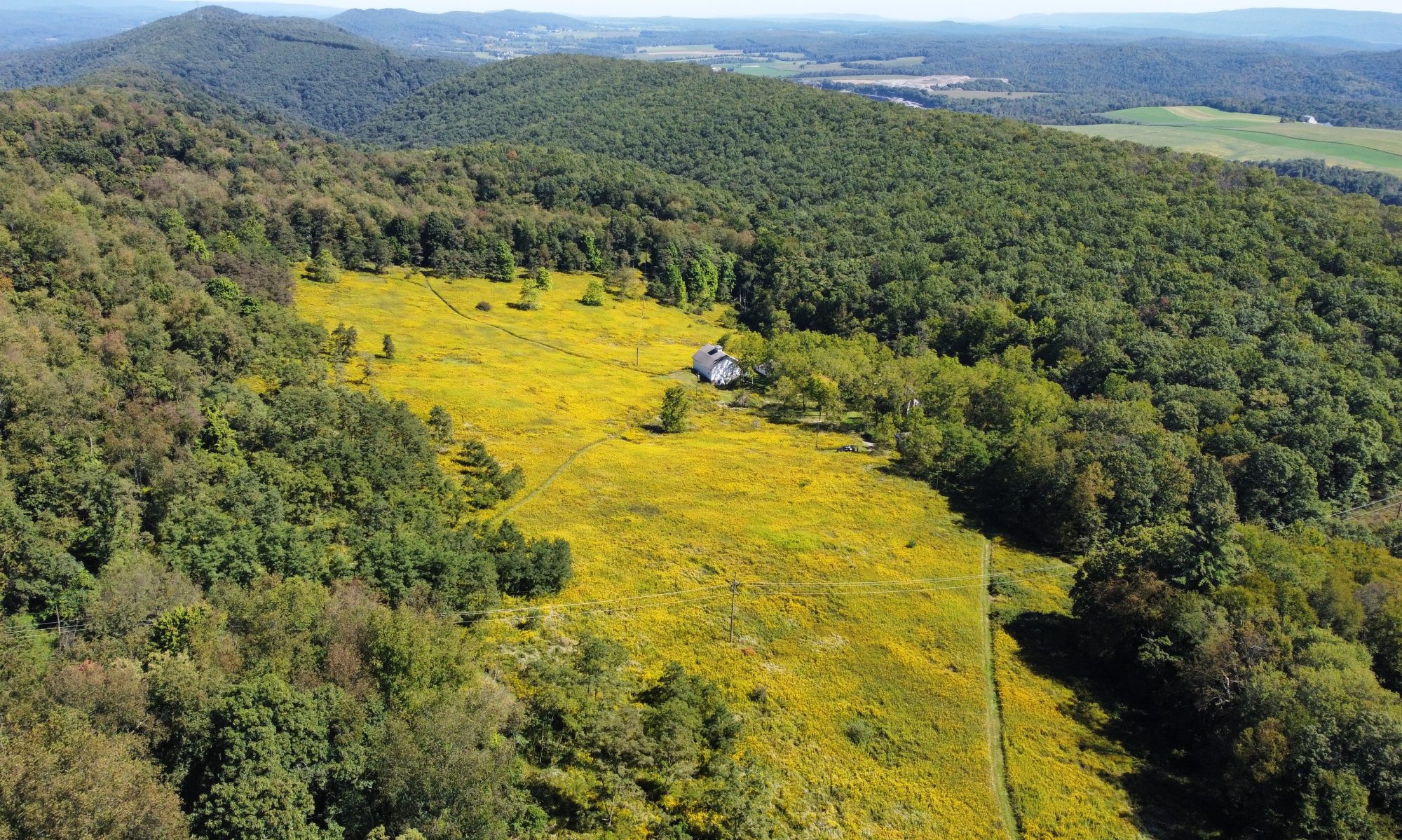
 Plummer's Hollow, Pennsylvania