
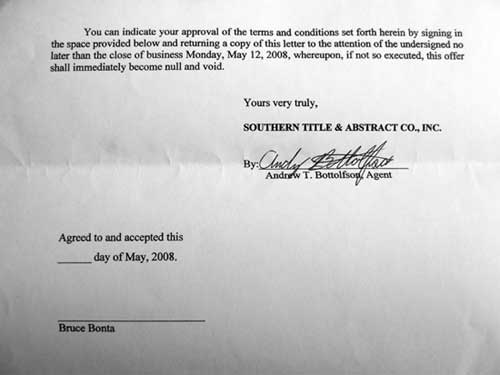
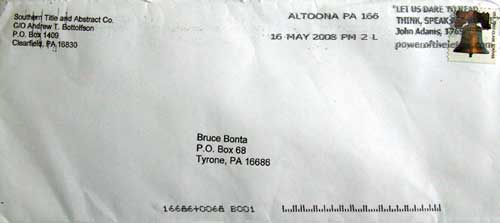
Alert readers will have already discovered several amusing things about this missive, which arrived unsolicited in this morning’s mail:
- Though purporting to be a lease proposal for Blair County in the subject line and first paragraph, it references the neighboring Cambria County in the “terms and conditions.” One might take this for a simple copy-and-paste error, except that the reference is specifically to the “initial bonus consideration” of $500.00 per acre. I’m not a lawyer, but it doesn’t take a whole lot of imagination to picture them saying, after one had already signed such a proposal in great anticipation of instant wealth (it would amount to over $300,000 for us), “Sorry, your land isn’t in Cambria County, so we don’t owe you anything!”
- “The royalty rate in the lease will be 1/8.” Uh, 1/8 of what, exactly? More weasel words designed to trap the unwary — or just extremely vague/sloppy language from people who do this for a living?
- It hardly takes any more time and ink to type “Carrizo” than CRZO, but the stock-ticker symbol is used throughout. Is this an attempt to garner respectability, to intimidate, or both?
- “CRZO’s activity in the area” could be harmed by the disclosure of the terms. Gee, I can’t imagine how!
- If not signed and returned by May 12, “the offer shall immediately become null and void.” OH NO, PAPPY, WE’RE SCREWED! QUICK, CALL ‘EM UP AND BEG FOR AN EXTENSION!
- Despite being dated May 5, the letter is actually postmarked 16 May 2008.
- The stamp cancelation text quotes John Adams: “Let us dare to read, think, speak, and write.” Yes, let’s.
The Google Finance page for Carrizo (linked above) makes note of their “acreage in shale plays in … the Marcellus in Pennsylvania/New York.” That is what’s at issue here: a deep deposit of natural gas that may be accessable from various parts of the Ridge-and-Valley geologic province, not just the Allegheny Plateau to our west and north where the shallower gas plays occur. As the New York Times put it last month:
A layer of rock here [in Pennsylvania] called the Marcellus Shale has been known for more than a century to contain gas, but it was generally not seen as economical to extract. Now, improved recovery technology, sharply higher natural gas prices and strong drilling results in a similar shale formation in north Texas are changing the calculus. A result is that a part of the country where energy supplies were long thought to be largely tapped out is suddenly ripe for gas prospecting. […]
Natural gas in the Marcellus and other shale formations is sometimes found as deep as 9,000 feet below the ground, a geological and engineering challenge not to be underestimated. The shales are sedimentary rock deposits formed from the mud of shallow seas several hundred million years ago. Gas can be found trapped within shale deposits, although it is too early to know exactly how much gas will be retrievable.
The Times article refers to the rush to sign leases as a feeding frenzy, and from what we hear, that’s not too far off the mark. Reportedly, some folks in Sinking Valley have already signed leases offering as little as $5.00 per acre! Other offers have gone as high as $600 per acre.
It probably goes without saying that we will never sign away any subsurface rights here on our property. In addition to very real concerns about groundwater contamination (Marcellus shale contains uranium), the main problem with gas drilling is habitat fragmentation. The Pennsylvania Department of Conservation and Natural Resources recently caved to pressure and opened up 75,000 acres of state forest land to gas drilling, reversing an earlier ban. Their claim is that the greater spacing between wells will lead to less forest fragmentation than would be the case with ordinary, shallow-well drilling, but environmentalists such as the Allegheny Defense Project’s Ryan Talbott, quoted in the linked article, respond that since the pads will be much larger, the difference is neglible. And it’s hard to see how more widely spaced clearings would reduce the number of roads and pipeline right-of-ways very much. Such linear corridors are the worst for spreading invasive plant species and giving access to nest predators on interior forest-dwelling birds, not to mention all-terrain vehicles (maybe that’s what the DCNR spokesflack meant by “other forest uses”).
Many interior forest species are already in steep decline, and it simply isn’t worth endangering them for what might be, at most, the equivalent of two years of total U.S. consumption if every recoverable cubic foot were exploited. We’re appalled that the official stewards of our state wildlands would consider trashing them to feed America’s fossil fuel addiction.
Well, people with dollar signs in their eyes are rarely given to honest discourse, be they state officials or “independent petroleum landmen.” But one thing is certain: geology-speak is really, really cool.
Bedding in the Marcellus is moderately well developed and fissile. Its upper reaches are marked by anoxic dark shales which indicate the Kačák Event, a late Eifelian stage marine anoxic event also associated with an extinction event. […]
The black and gray shales of the Hamilton Group mark the first terrigenous sediments deposited by the erosion of the Acadian Mountains. These sediments were deposited in the Acadian foredeep basin early in the Acadian orogeny, as part of a deep water sequence that continued to form the overlying Brallier Formation and Harrell Formation. The Marcellus Shale was formed from the very first sediments deposited in this very deep, sediment starved, anoxic trough. The dark shale is composed of flysch, a fine mud deposited in the deep water, burying the underlying Onondoga limestone beds.
It would be nice if the Kačák Event were the last extinction to be associated with these deposits.
–Dave
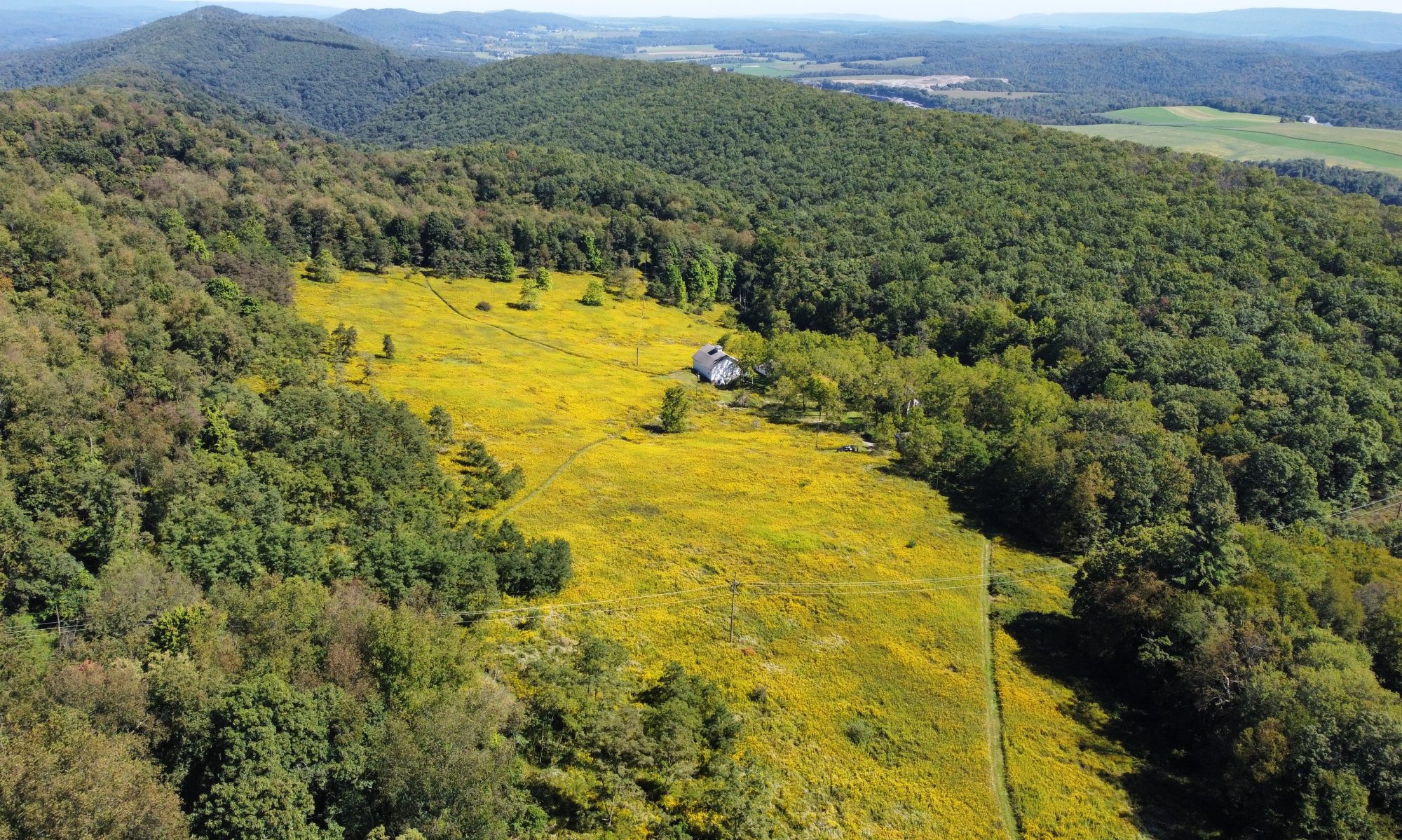
 Plummer's Hollow, Pennsylvania